
Pocono Summit is a true toss-up. About 49% of voters here vote Democratic and 51% Republican.
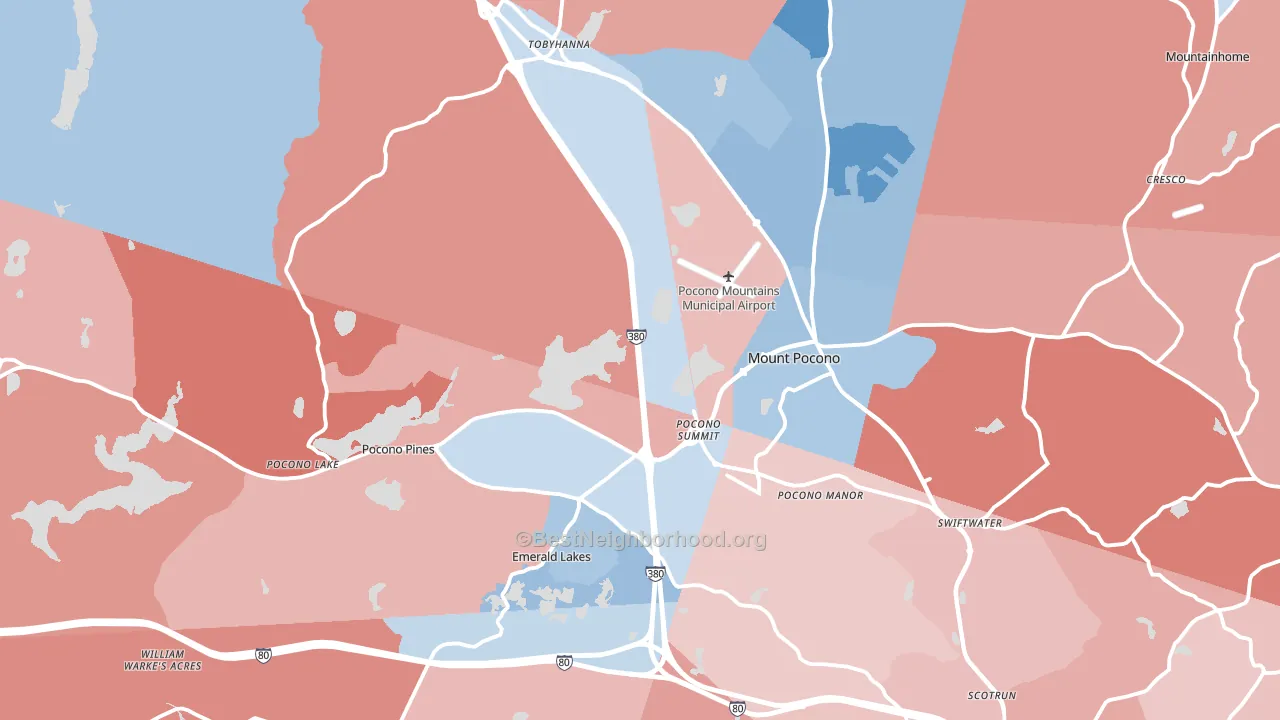
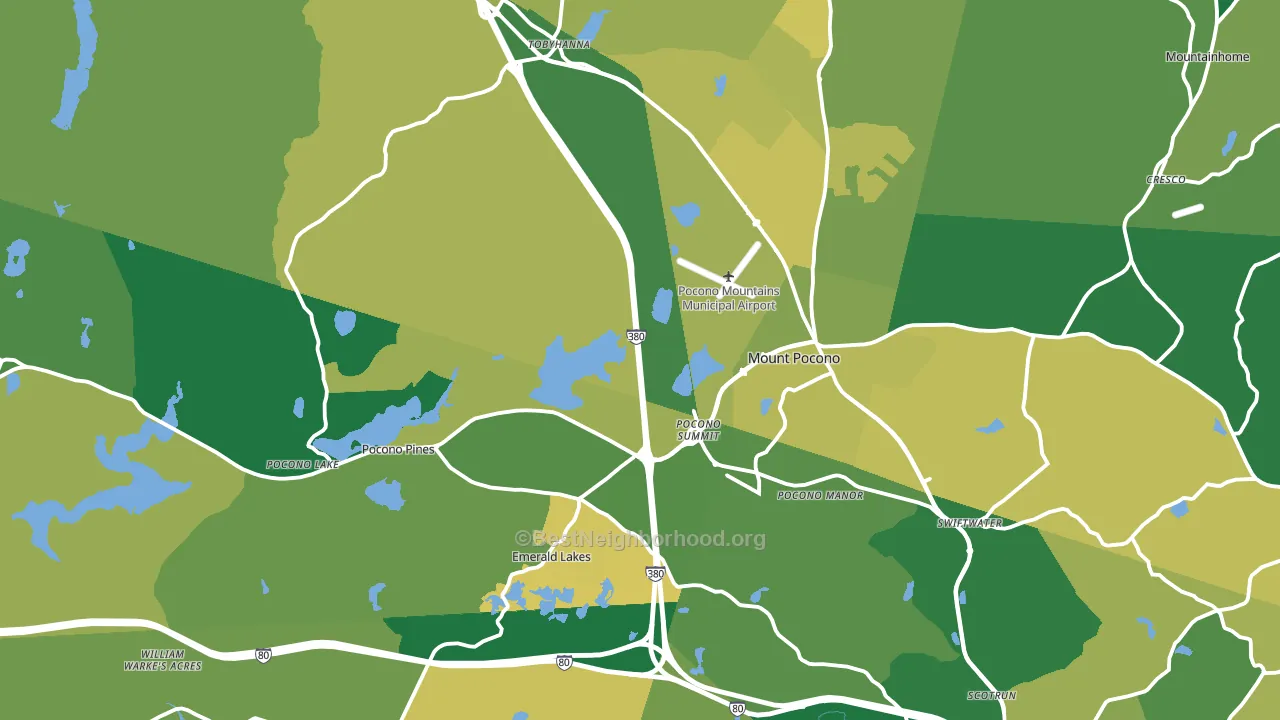
About 79% of adults in Pocono Summit typically vote, above the U.S. average of about 62%. Among adults in Pocono Summit, ~39% vote Democratic, ~40% Republican, and ~21% don't vote. The map below shows estimated turnout by block group.
How Pocono Summit compares
Among cities within 25 miles, Pocono Summit sits roughly in the middle of the political spectrum, with 15 neighbors leaning further in the place's direction and 112 leaning the other way.
Politically, Pocono Summit sits close to the rest of Pennsylvania.
Politics vary noticeably by neighborhood within Pocono Summit. The north side runs the most Democratic (D+4) and the northwest side runs the most Republican (R+21), a spread of about 26 points.
Why Pocono Summit leans the way it does
Density, race composition, education, and family structure all sit close to their national averages in Pocono Summit. The lean here lands roughly where demographic data alone would predict.
Renting and voter turnout
Places with homeowner-heavy households tend to turn out at a higher rate; Pocono Summit, PA sits in the bottom tenth nationally on this measure.
Why turnout in Pocono Summit looks the way it does
Homeowners vote more often than renters. About 94% of households in Pocono Summit own their home, about 15 points above the Pennsylvania average of 79%. Learn more about the findings and methodology on the political spectrum map.
Nearby Cities
- Mount Pocono, PA D+12
- Pocono Manor, PA R+17
- Long Pond, PA D+5
- Pocono Pines, PA R+12
- Scotrun, PA R+9
- Tobyhanna, PA D+32
- Swiftwater, PA R+14
- Buck Hill Falls, PA D+5
- Paradise Valley, PA R+23
- Tannersville, PA R+10
Cities with Similar Populations
- Fillmore, IN R+58
- Leming, TX R+42
- Shelburn, IN R+58
- South Padre Island, TX R+22
- Nunda, NY R+41
- New Castle, VA R+64
- Hamilton, MS R+61
- Laurelville, OH R+56
- Belfry, KY R+70
- Grandy, NC R+50
Sources and methodology
Precinct-level voting records used to fit the model come from Pennsylvania Department of State, Bureau of Elections, distributed by the Voting and Election Science Team. Demographic inputs come from the U.S. Census Bureau (ACS 5-year estimates and the 2020 Decennial Census). Health and environmental inputs come from the CDC (PLACES and the Environmental Justice Index). Land cover comes from the USGS and EPA. Election-day and lead-up weather come from PRISM 4km daily grids and the NOAA Global Historical Climatology Network. Mail-voting and election-administration patterns come from the MIT Election Lab's Survey of the Performance of American Elections. Block-group crime detail comes from CrimeGrade. Internet data and modeling support provided by ISPreports.org.
Modeling and analysis by the BestNeighborhood data science team. Full methodology and findings: political spectrum map.
Methodology reviewed by the BestNeighborhood data team. Last updated May 2026.