
Springfield-Belmont is a Democratic stronghold. About 89% of voters here vote Democratic and 11% Republican.
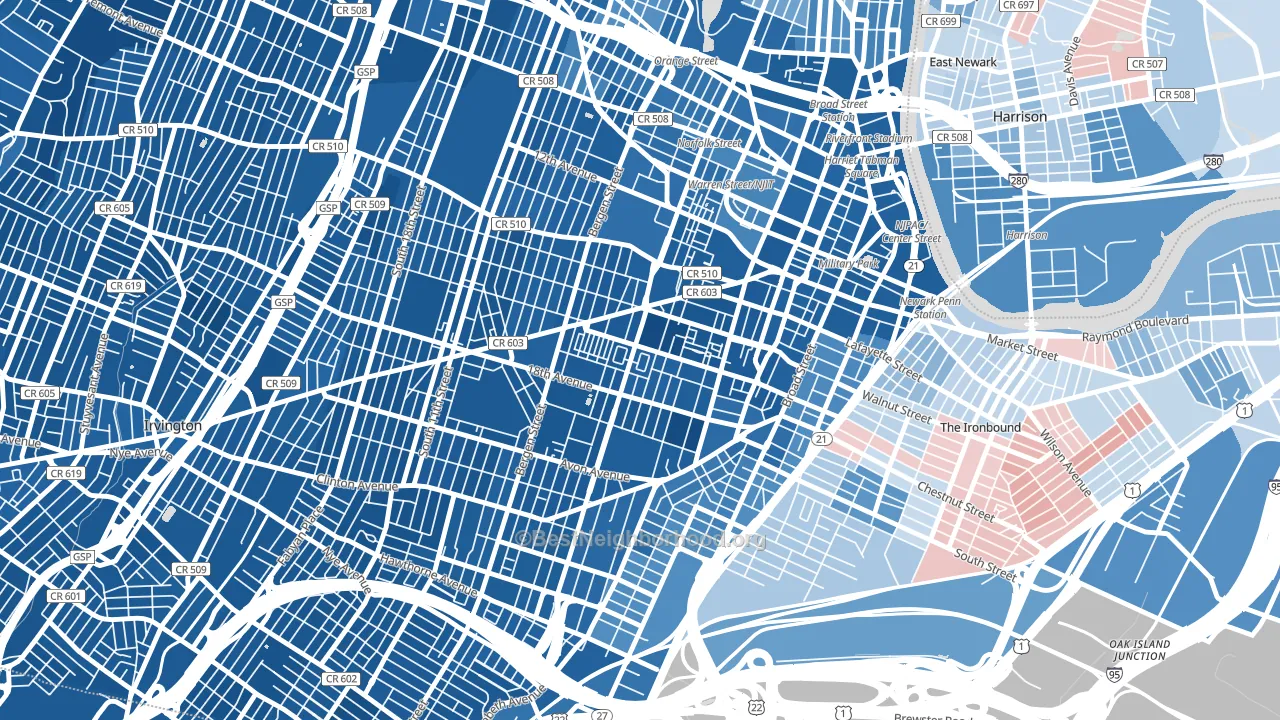
About 46% of adults in Springfield-Belmont typically vote, below the U.S. average of about 62%. Among adults in Springfield-Belmont, ~41% vote Democratic, ~5% Republican, and ~54% don't vote. The map below shows estimated turnout by block group.
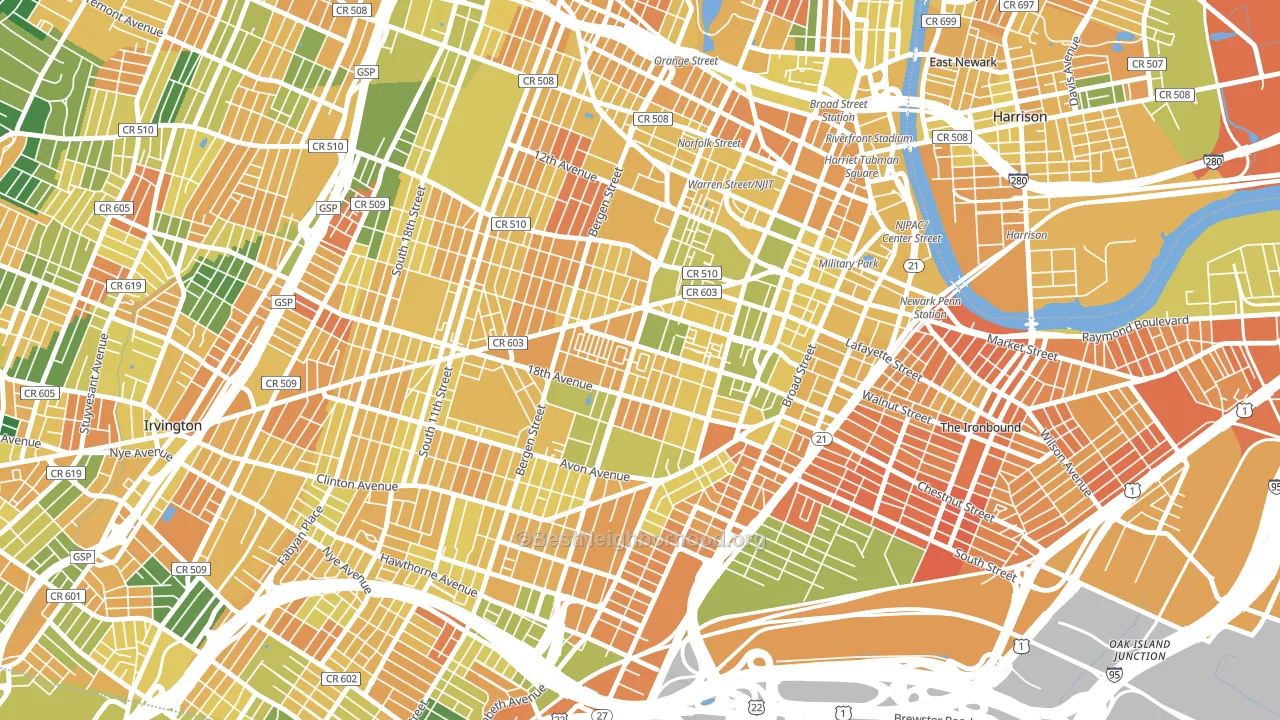
How Springfield-Belmont compares
Among neighborhoods within 5 miles, Springfield-Belmont leans more Democratic than 18 of 22 neighbors.
Springfield-Belmont runs about 72 points more Democratic than New Jersey as a whole.
Why Springfield-Belmont leans the way it does
This analysis examined 14,881 data points per neighborhood to find what predicts political lean and turnout. The items below are a few correlations that stood out for Springfield-Belmont, not a ranked or complete list of what matters most.
Dense areas vote Democratic. More than 99% of residents in Springfield-Belmont live in densely developed areas, about 64 points above the U.S. average of 36%. A high never-married share predicts Democratic voting, and about 57% of adults in Springfield-Belmont have never been married, above 91% of neighborhoods.
Population density and Democratic lean
Places with high population density tend to lean Democratic; Springfield-Belmont, Newark, NJ sits in the top tenth nationally on this measure.
Why turnout in Springfield-Belmont looks the way it does
Areas with limited routine healthcare access turn out at lower rates. Springfield-Belmont is in the bottom quarter nationally for routine-care measures such as insurance coverage, preventive screenings, and dental visits. The dental-visit rate here is about 44%, about 23 points below the New Jersey average of 68%. Renters vote less often than owners, and about 89% of households in Springfield-Belmont rent, about 64 points above the U.S. average of 25%. High food insecurity lines up with lower turnout, and about 46% of adults in Springfield-Belmont report food insecurity, above 97% of neighborhoods. Learn more about the findings and methodology on the political spectrum map.
Nearby Neighborhoods
- South Broad Street, Newark, NJ D+63
- University Heights, Newark, NJ D+67
- Central Business District, Newark, NJ D+72
- Lower Clinton Hill, Newark, NJ D+79
- Fairmuont, Newark, NJ D+73
- Upper Clinton Hill, Newark, NJ D+80
- South Ironbound, Newark, NJ D+25
- Seventh Avenue, Newark, NJ D+45
- North Ironbound, Newark, NJ D+5
- Lower Roseville, Newark, NJ D+48
Neighborhoods with Similar Populations
- North Plymouth, Plymouth, MA D+16
- Magnolia Center, Riverside, CA D+8
- Stadium-Armory, Washington, DC D+85
- Fremont, Seattle, WA D+79
- West Pullman, Chicago, IL D+82
- Central, Fresno, CA D+30
- Ponderosa Park, Sunnyvale, CA D+34
- Los Altos, Long Beach, CA D+24
- Mercury Central, Hampton, VA D+47
- Crescenta Highlands, La Crescenta, CA D+22
Sources and methodology
Precinct-level voting records used to fit the model come from New Jersey Division of Elections, distributed by the Voting and Election Science Team. Demographic inputs come from the U.S. Census Bureau (ACS 5-year estimates and the 2020 Decennial Census). Health and environmental inputs come from the CDC (PLACES and the Environmental Justice Index). Land cover comes from the USGS and EPA. Election-day and lead-up weather come from PRISM 4km daily grids and the NOAA Global Historical Climatology Network. Mail-voting and election-administration patterns come from the MIT Election Lab's Survey of the Performance of American Elections. Block-group crime detail comes from CrimeGrade. Internet data and modeling support provided by ISPreports.org.
Modeling and analysis by the BestNeighborhood data science team. Full methodology and findings: political spectrum map.
Methodology reviewed by the BestNeighborhood data team. Last updated May 2026.