
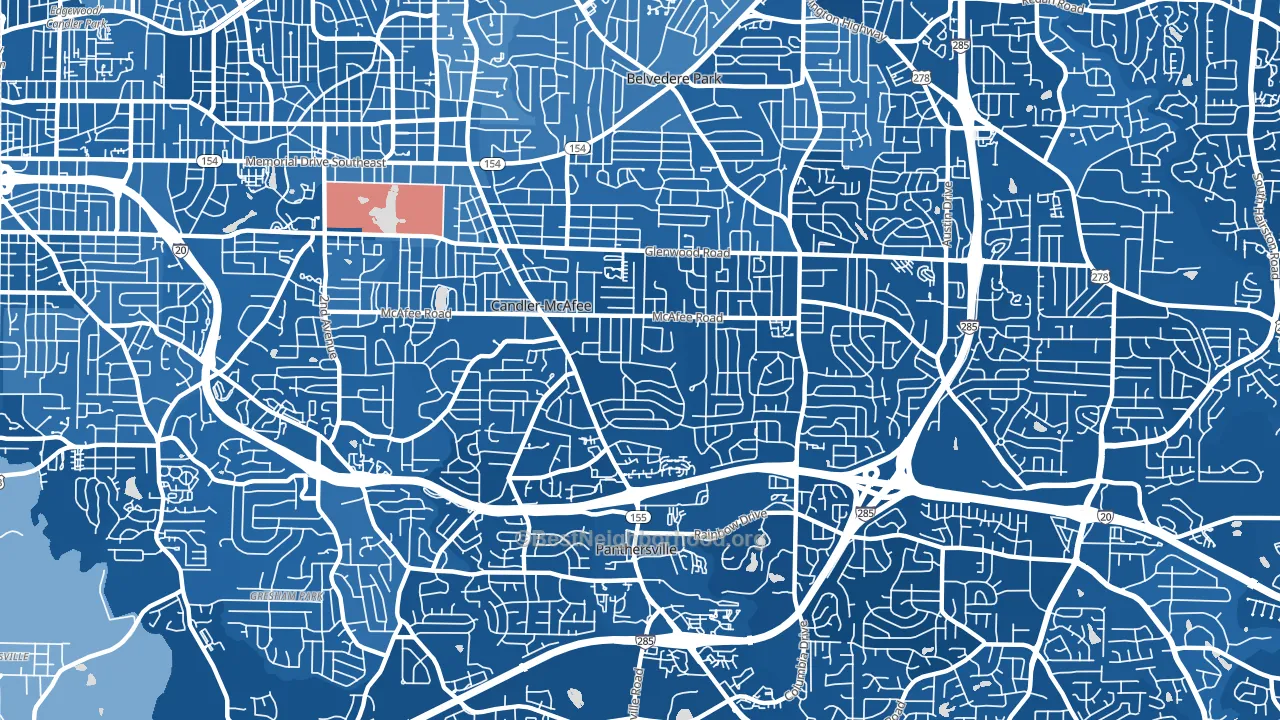
Candler-McAfee is a Democratic stronghold. About 92% of voters here vote Democratic and 8% Republican.
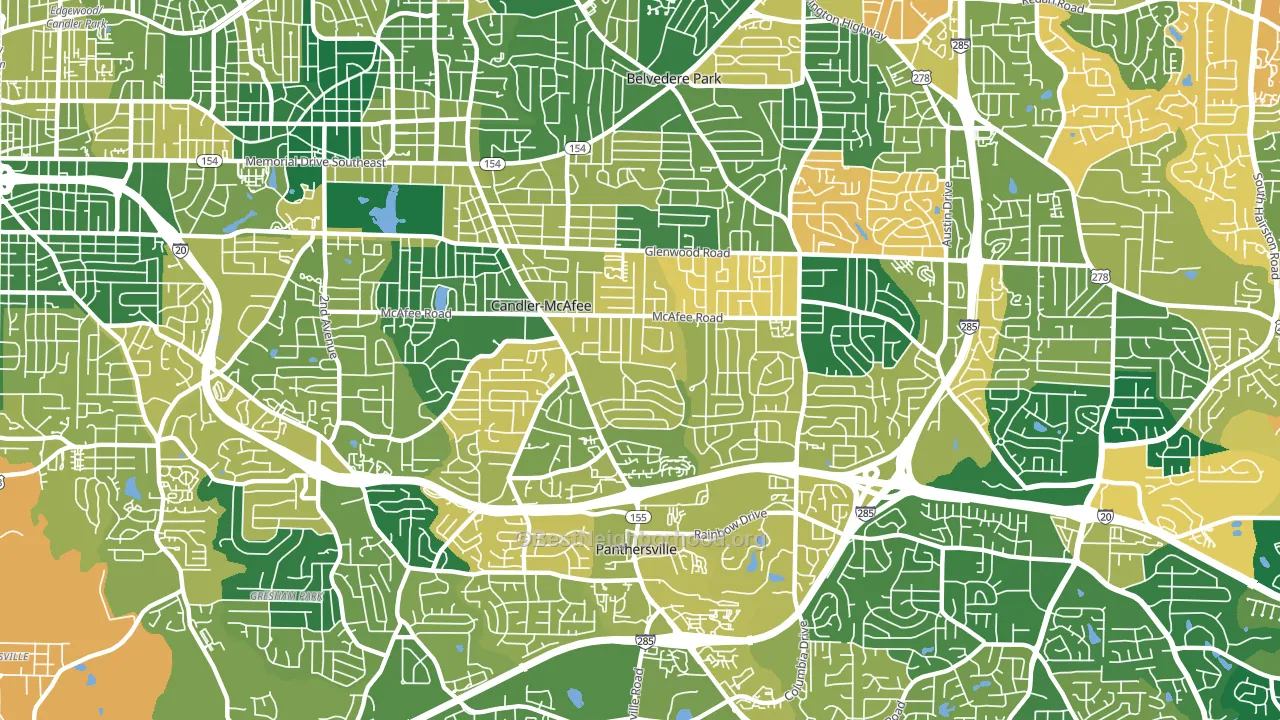
About 73% of adults in Candler-McAfee typically vote, above the U.S. average of about 62%. Among adults in Candler-McAfee, ~67% vote Democratic, ~6% Republican, and ~27% don't vote. The map below shows estimated turnout by block group.
How Candler-McAfee compares
Among cities within 25 miles, Candler-McAfee leans more Democratic than 62 of 64 neighbors.
Candler-McAfee runs about 86 points more Democratic than Georgia as a whole. Georgia is roughly evenly split, and Candler-McAfee sits clearly on the Democratic side.
Politics vary noticeably by neighborhood within Candler-McAfee. The east side is the most Democratic-leaning (D+87) and the northwest side is the least Democratic-leaning (D+75), a spread of about 12 points.
Why Candler-McAfee leans the way it does
This analysis examined 14,881 data points per city to find what predicts political lean and turnout. The items below are a few correlations that stood out for Candler-McAfee, not a ranked or complete list of what matters most.
Dense areas vote Democratic. About 94% of residents in Candler-McAfee live in densely developed areas, about 58 points above the U.S. average of 36%. A high never-married share predicts Democratic voting, and about 48% of adults in Candler-McAfee have never been married, above 97% of cities. Candler-McAfee runs against the grain of Georgia, a Democratic-leaning outlier in a roughly evenly split state.
Paved land cover and Democratic lean
Places with extensive paved surfaces tend to lean Democratic; Candler-McAfee, GA sits in the top tenth nationally on this measure. Paved ground does not change how people vote; it mostly reflects how urban and built-up a place is.
Why turnout in Candler-McAfee looks the way it does
Areas with strong routine healthcare access turn out at higher rates. Candler-McAfee is in the top quarter nationally for routine-care measures such as insurance coverage, preventive screenings, and dental visits. The dental-visit rate here is about 53%, about 7 points below the U.S. average of 60%. Learn more about the findings and methodology on the political spectrum map.
Nearby Cities
- Decatur, GA D+74
- Panthersville, GA D+86
- Belvedere Park, GA D+78
- Avondale Estates, GA D+63
- Scottdale, GA D+62
- Druid Hills, GA D+61
- North Decatur, GA D+54
- Pine Lake, GA D+77
- Clarkston, GA D+57
- Conley, GA D+78
Cities with Similar Populations
- Canfield, OH R+22
- East Renton Highlands, WA D+23
- Gretna, LA D+20
- Seaford, DE R+10
- Acton, MA D+43
- Fountain Inn, SC R+30
- Oroville, CA R+21
- Union Hill-Novelty Hill, WA D+33
- Lebanon, MO R+55
- Stony Brook, NY D+23
Sources and methodology
Precinct-level voting records used to fit the model come from Georgia Elections Division, distributed by the Voting and Election Science Team. Demographic inputs come from the U.S. Census Bureau (ACS 5-year estimates and the 2020 Decennial Census). Health and environmental inputs come from the CDC (PLACES and the Environmental Justice Index). Land cover comes from the USGS and EPA. Election-day and lead-up weather come from PRISM 4km daily grids and the NOAA Global Historical Climatology Network. Mail-voting and election-administration patterns come from the MIT Election Lab's Survey of the Performance of American Elections. Block-group crime detail comes from CrimeGrade. Internet data and modeling support provided by ISPreports.org.
Modeling and analysis by the BestNeighborhood data science team. Full methodology and findings: political spectrum map.
Methodology reviewed by the BestNeighborhood data team. Last updated May 2026.