
Population 260 · Census ACS 2020–24
Choose a measure to map it.Tap a measure to map it. Swipe the row for more. Arrows show the change since 2006–10.
Median age by neighborhoodHistory and comparison ↓︎
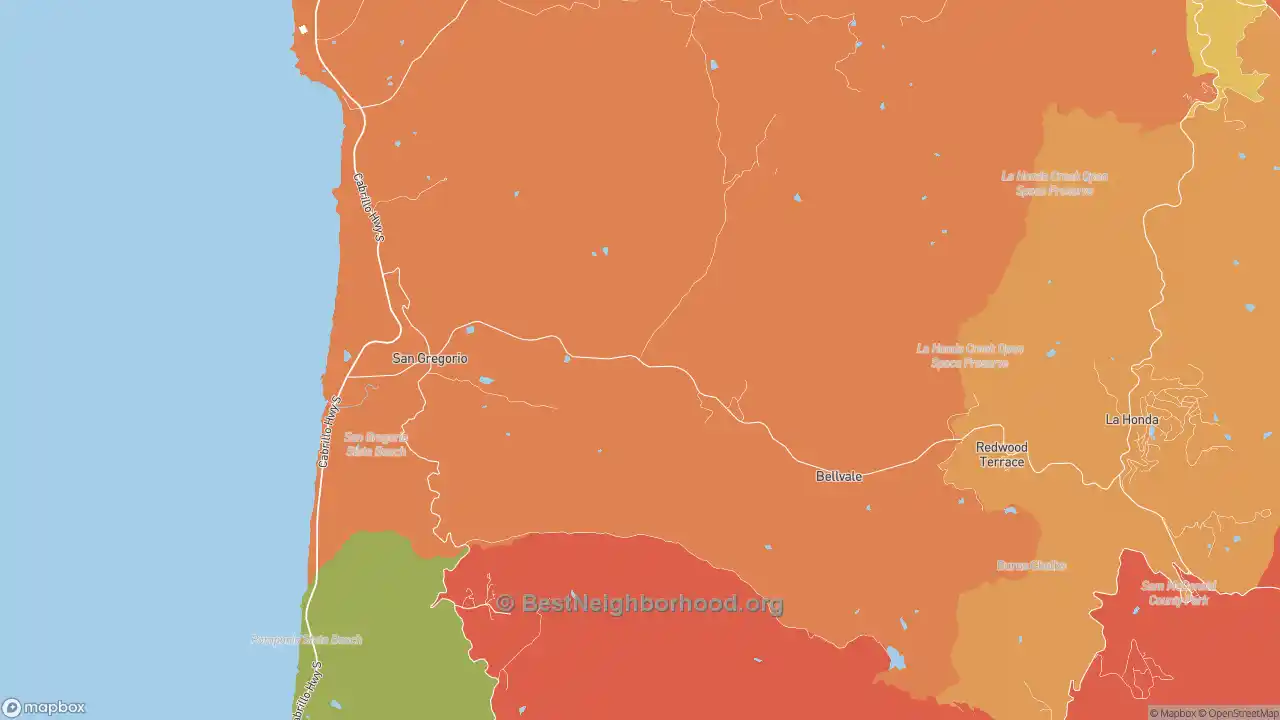
Younger residents
Older residents
Colorblind friendly
off
More maps of San Gregorio: Best Neighborhoods · Walk Grade · Household income · Home prices · Race · Politics · Traffic noise · Internet
Population and households in San Gregorio
Household size in San Gregorio
| Period | San Gregorio | San Francisco area | California | U.S. |
|---|---|---|---|---|
| 2006–10 | 1.84 | 2.74 | 3.04 | 2.68 |
| 2010–14 | 2.22 | 2.79 | 3.10 | 2.73 |
| 2015–19 | 2.54 | 2.83 | 3.09 | 2.71 |
| 2020–24 | 2.90 | 2.75 | 3.01 | 2.65 |
| Change | +1.06 | +0.01 | −0.03 | −0.03 |
The typical household in San Gregorio holds 2.90 people, more than the U.S. average of 2.65. Since 2006–10, household size has climbed from 1.84, but in a place this small, survey estimates can swing a lot from one release to the next.
Household size: the average number of people living in each occupied home. Source: BestNeighborhood calculations from U.S. Census Bureau ACS 5-year block-group estimates (table B25010).
Median age in San Gregorio
| Period | San Gregorio | San Francisco area | California | U.S. |
|---|---|---|---|---|
| 2006–10 | 48.5 | 38.6 | 35.8 | 37.7 |
| 2010–14 | 53.0 | 39.4 | 36.8 | 38.6 |
| 2015–19 | 47.9 | 40.1 | 37.9 | 39.6 |
| 2020–24 | 42.8 | 41.3 | 39.0 | 40.1 |
| Change | −5.7 | +2.7 | +3.1 | +2.3 |
The median resident of San Gregorio is 42.8 years old, a bit older than the national median of 40.1. The picture is much the same across the San Francisco area.
Median age: the age that splits residents into two equal halves. Source: BestNeighborhood calculations from U.S. Census Bureau ACS 5-year block-group estimates (table B01002).
Single-parent households in San Gregorio
| Period | San Gregorio | San Francisco area | California | U.S. |
|---|---|---|---|---|
| 2006–10 | 4.6% | 10.3% | 13.5% | 12.3% |
| 2010–14 | 6.4% | 9.9% | 13.5% | 12.3% |
| 2015–19 | 1.4% | 9.1% | 12.3% | 11.6% |
| 2020–24 | 19.4% | 8.8% | 12.3% | 11.6% |
| Change | +14.8 pts | −1.5 pts | −1.2 pts | −0.6 pts |
Single-parent households are common in San Gregorio: 19.4% of all households, against 11.6% nationally.
Single-parent households: households where one adult with no spouse present lives with children under 18. Source: BestNeighborhood calculations from U.S. Census Bureau ACS 5-year block-group estimates (table B11003).
Housing in San Gregorio
Renters in San Gregorio
| Period | San Gregorio | San Francisco area | California | U.S. |
|---|---|---|---|---|
| 2006–10 | 25.4% | 43.7% | 42.6% | 33.3% |
| 2010–14 | 19.2% | 46.2% | 45.2% | 35.6% |
| 2015–19 | 26.3% | 45.3% | 45.2% | 36.0% |
| 2020–24 | 30.5% | 44.5% | 44.1% | 34.8% |
| Change | +5.1 pts | +0.8 pts | +1.5 pts | +1.5 pts |
About three in ten households in San Gregorio rent their homes (30.5%), a little below the national share of 34.8%; the rest own. More than a third of owners (36.0%) have paid off their mortgages, below the national share of 39.8%.
Renters: occupied homes that are rented rather than owned. Source: BestNeighborhood calculations from U.S. Census Bureau ACS 5-year block-group estimates (table B25003).
Vacant homes in San Gregorio
| Period | San Gregorio | San Francisco area | California | U.S. |
|---|---|---|---|---|
| 2006–10 | 18.7% | 8.6% | 8.7% | 11.4% |
| 2010–14 | 16.2% | 7.1% | 8.1% | 11.4% |
| 2015–19 | 25.9% | 6.5% | 7.5% | 11.1% |
| 2020–24 | 27.7% | 7.5% | 7.3% | 9.6% |
| Change | +9.0 pts | −1.1 pts | −1.4 pts | −1.8 pts |
Vacant homes make up 27.7% of the housing in San Gregorio, far above the national rate of 9.6%. In resort and lake areas that usually means seasonal and vacation homes; elsewhere it can point to weak demand.
Vacant homes: homes with no one living in them, including vacation homes and homes for sale or rent. Source: BestNeighborhood calculations from U.S. Census Bureau ACS 5-year block-group estimates (table B25002).
Age of homes in San Gregorio
| Period | San Gregorio | San Francisco area | California | U.S. |
|---|---|---|---|---|
| 2006–10 | 1957 | 1964 | 1972 | 1974 |
| 2010–14 | 1975 | 1965 | 1973 | 1975 |
| 2015–19 | 1961 | 1966 | 1974 | 1977 |
| 2020–24 | 1981 | 1968 | 1976 | 1980 |
| Change | +23 | +4 | +4 | +6 |
The typical home in San Gregorio was built around 1981, about the same vintage as the country's housing overall (1980). Homes here are newer than in the San Francisco area overall, where the median home dates to 1968.
Age of homes: the year that splits the housing stock into older and newer halves. Source: BestNeighborhood calculations from U.S. Census Bureau ACS 5-year block-group estimates (table B25035).
Rent in San Gregorio
| Period | San Gregorio | San Francisco area | California | U.S. |
|---|---|---|---|---|
| 2006–10 | $644 | $1,452 | $1,298 | $965 |
| 2010–14 | $1,948 | $1,551 | $1,379 | $1,040 |
| 2015–19 | $2,180 | $2,139 | $1,721 | $1,213 |
| 2020–24 | $1,148 | $2,666 | $2,229 | $1,571 |
| Change | +$504 | +$1,214 | +$931 | +$606 |
The median renter in San Gregorio pays $1,148 a month for rent and utilities, well below the national median of $1,571. Rent takes 16.4% of the typical renter's income, comfortably under the 30% mark often used to define affordable rent.
Rent: monthly rent plus the utilities renters pay themselves. Source: BestNeighborhood calculations from U.S. Census Bureau ACS 5-year block-group estimates (table B25064).
Education in San Gregorio
Bachelor's degrees in San Gregorio
| Period | San Gregorio | San Francisco area | California | U.S. |
|---|---|---|---|---|
| 2006–10 | 43.9% | 42.5% | 29.1% | 28.4% |
| 2010–14 | 27.5% | 44.1% | 30.1% | 29.6% |
| 2015–19 | 41.6% | 48.9% | 32.9% | 32.1% |
| 2020–24 | 32.3% | 52.2% | 36.3% | 35.6% |
| Change | −11.6 pts | +9.7 pts | +7.1 pts | +7.2 pts |
About a third of adults 25 and older in San Gregorio (32.3%) have a bachelor's degree or higher, a little below the national share of 35.6%.
Bachelor's degrees: adults 25 and older with a bachelor's degree or higher. Source: BestNeighborhood calculations from U.S. Census Bureau ACS 5-year block-group estimates (table B15003).
High school graduates in San Gregorio
| Period | San Gregorio | San Francisco area | California | U.S. |
|---|---|---|---|---|
| 2006–10 | 88.2% | 86.8% | 79.9% | 84.9% |
| 2010–14 | 96.2% | 87.5% | 80.7% | 86.1% |
| 2015–19 | 92.8% | 88.8% | 82.6% | 87.7% |
| 2020–24 | 89.5% | 89.1% | 84.2% | 89.3% |
| Change | +1.4 pts | +2.3 pts | +4.3 pts | +4.3 pts |
High school completion in San Gregorio is close to the national rate: 89.5% of adults have a diploma or equivalent, against 89.3%.
High school graduates: adults 25 and older with a high school diploma, GED or more. Source: BestNeighborhood calculations from U.S. Census Bureau ACS 5-year block-group estimates (table B15003).
Jobs in San Gregorio
| Period | San Gregorio | San Francisco area | California | U.S. |
|---|---|---|---|---|
| 2006–10 | 2.1% | 7.8% | 9.2% | 8.1% |
| 2010–14 | 3.5% | 8.9% | 11.3% | 9.4% |
| 2015–19 | 0.0% | 4.6% | 6.3% | 5.6% |
| 2020–24 | 0.2% | 5.8% | 6.6% | 5.4% |
| Change | −1.9 pts | −2.0 pts | −2.6 pts | −2.7 pts |
Unemployment in San Gregorio has been low: just 0.2% of the labor force was out of work and looking, well below the national rate of 5.4%. Because the Census pools five years of responses (2020–24), these rates smooth over short swings and lag the current job market.
Unemployment: people looking for work as a share of everyone working or looking. Source: BestNeighborhood calculations from U.S. Census Bureau ACS 5-year block-group estimates (table B23025).
San Gregorio compared with nearby cities
| City | Household size | Median age | Single parents | Renters | Vacant homes | Median year built | Median rent | Bachelor's degree | High school diploma | Unemployment |
|---|---|---|---|---|---|---|---|---|---|---|
| San Gregorio | 2.90 | 42.8 | 19.4% | 30.5% | 27.7% | 1981 | $1,148 | 32.3% | 89.5% | 0.2% |
| Redwood Terrace | 2.29 | 45.3 | 7.1% | 27.9% | 17.1% | 1954 | $1,188 | 61.8% | 86.3% | 1.3% |
| Loma Mar | 2.27 | 54.7 | 3.4% | 21.3% | 38.1% | 1974 | $2,721 | 49.3% | 89.0% | 4.7% |
| Sky Londa | 2.78 | 42.9 | 8.1% | 23.3% | 17.2% | 1965 | $2,317 | 64.4% | 92.6% | 1.9% |
| La Honda | 2.21 | 49.1 | 3.4% | 25.9% | 21.5% | 1956 | $1,744 | 63.8% | 86.6% | 2.7% |
| Pescadero | 4.08 | 41.2 | 3.4% | 40.0% | 20.4% | 1988 | $1,426 | 43.0% | 73.2% | 4.9% |
| Portola Valley | 2.55 | 56.8 | 2.0% | 17.3% | 8.3% | 1966 | $3,499 | 81.9% | 94.2% | 3.9% |
| Woodside | 2.94 | 43.1 | 5.1% | 14.6% | 9.3% | 1966 | $3,298 | 74.5% | 99.0% | 4.3% |
| Half Moon Bay | 2.78 | 47.6 | 7.9% | 25.3% | 9.7% | 1981 | $2,491 | 53.3% | 91.8% | 2.3% |
| Miramar | 3.22 | 44.3 | 5.5% | 32.8% | 4.5% | 1981 | $2,937 | 55.2% | 90.1% | 5.0% |
| Atherton | 2.78 | 44.1 | 4.0% | 16.2% | 15.9% | 1963 | $3,422 | 80.5% | 97.7% | 3.7% |
All figures 2020–24.
Cities with similar populations: Greilickville, MI · Hargetts Crossroads, NC · Hardenville, MO · Hanging Rock, OH · Hamlin, KY · Hamlin, IA · Hamilton, IA · Halsell, AL · Halma, MN · Halls Summit, KS
About these numbers
Every figure on this page is a BestNeighborhood calculation from the Census Bureau's American Community Survey (ACS), built up from the Census block groups that make up San Gregorio. Each ACS 5-year release pools five years of responses; this page shows the last 15 releases, 2006–10 through 2020–24. Neighboring releases share four of their five years, so they move gradually and small changes between them are within the survey's margin of error; in small places the lines can jump from one release to the next for the same reason. The maps show the same measures for each neighborhood, ranked against the whole country.
No other site shows detail at this level for free. We are able to keep this site free by receiving a small commission from the referring links on this page. Please share or cite this page if you aren’t able to otherwise support our work.