
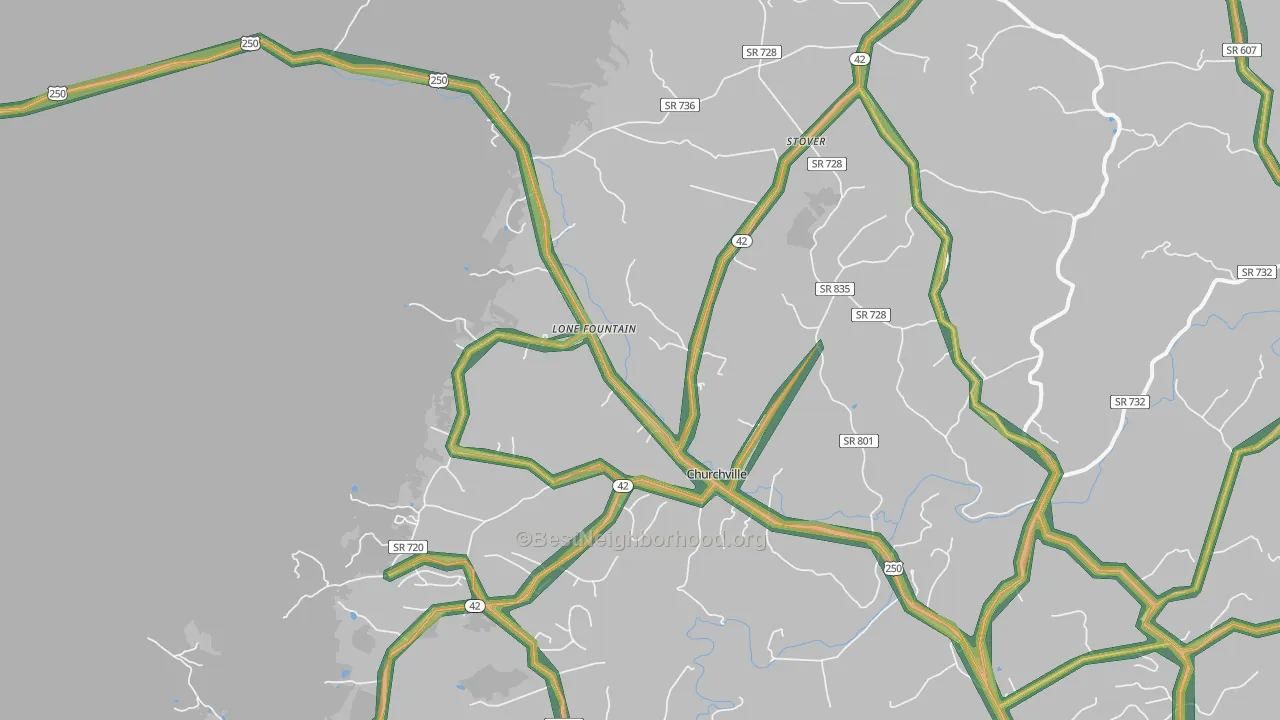
This map shows modeled outdoor noise across 24421 at 100-meter resolution, combining road, aviation, and rail sources. Green areas measure below 45 dBA. Orange and red exceed the EPA's 55 dBA outdoor threshold linked to long-term health effects. Use the layer toggles to view each source on its own or all together.
What the numbers sound like
- 30 dBAWhisper
- 40 dBASoft rainfall
- 45 dBAQuiet suburban street at night
- 50 dBAQuiet office
- 55 dBAEPA outdoor threshold: light traffic 100 ft away
- 60 dBANormal conversation an arm's length away
- 65 dBABusy restaurant
- 70 dBAHighway traffic 50 ft away
- 80 dBACity bus interior
Population Above the EPA Outdoor Threshold
The EPA's 55 dBA outdoor reference level is a common benchmark for residential noise exposure, especially for activity interference, annoyance, and long-term community noise concerns. About 159 24421 residents, or 4.8%, live above that level. By land area, 6.6% of 24421 is above 55 dBA.
See how noise in 24421 compares to similar-sized zip codes.
Noise by Part of 24421
Average noise levels for 24421 residents, grouped by direction from the center of 24421. The highest population-weighted average is in southeastern 24421; the lowest is in northwestern 24421, where just 1% of residents live in blocks above the EPA's 55 dBA threshold, about half the share in the loudest section.
Southeastern 24421
3% of people above 55 dBA
Southern 24421
2% of people above 55 dBA
Northeastern 24421
2% of people above 55 dBA
Western 24421
1% of people above 55 dBA
Northwestern 24421
1% of people above 55 dBA
To the human ear, noise in southeastern 24421 sounds about 42% louder than in northwestern 24421, a 5.1 dBA gap. Every 10 dBA roughly doubles perceived loudness. Within any of these directions, two homes a quarter mile apart can still differ by 10 or more dBA depending on how close they sit to a major highway.
How far back from 493-SANDY do you need to be?
493-SANDY produces an estimated 57 dBA at its loudest centerline points. Noise drops logarithmically with distance, with the exact rate depending on what's between you and the road. Tree cover, walls, terrain, and pavement type all matter. At roughly a quarter mile back, traffic fades into the noise level of a soft rainfall.
Calculated from the model's calibrated attenuation formula. About 40% of 24421 sits under tree canopy (heavier than most zip codes) and roughly 1% is impervious surface like pavement and rooftops. Both are folded into the per-place decay rate above. Heavier canopy pulls noise down faster with distance; impervious surfaces slow the drop.