
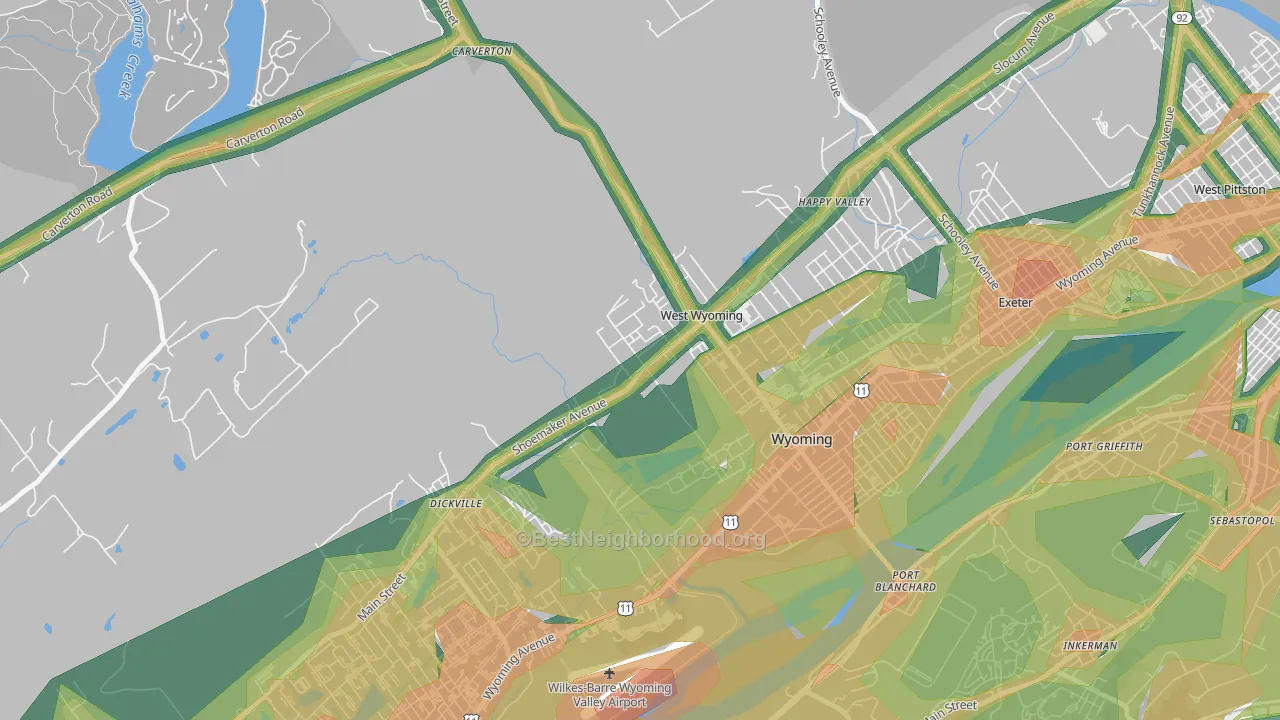
This map shows modeled outdoor noise across West Wyoming at 100-meter resolution, combining road, aviation, and rail sources. Green areas measure below 45 dBA. Orange and red exceed the EPA's 55 dBA outdoor threshold linked to long-term health effects. Use the layer toggles to view each source on its own or all together.
What the numbers sound like
- 30 dBAWhisper
- 40 dBASoft rainfall
- 45 dBAQuiet suburban street at night
- 50 dBAQuiet office
- 55 dBAEPA outdoor threshold: light traffic 100 ft away
- 60 dBANormal conversation an arm's length away
- 65 dBABusy restaurant
- 70 dBAHighway traffic 50 ft away
- 80 dBACity bus interior
Population Above the EPA Outdoor Threshold
The EPA's 55 dBA outdoor reference level is a common benchmark for residential noise exposure, especially for activity interference, annoyance, and long-term community noise concerns. About 683 West Wyoming residents, or 27.1%, live above that level. By land area, 37.4% of West Wyoming is above 55 dBA.
See how noise in West Wyoming compares to similar-sized cities.
Noise by Part of West Wyoming
Average noise levels for West Wyoming residents, grouped by direction from the center of West Wyoming. The highest population-weighted average is in southwestern West Wyoming; the lowest is in northwestern West Wyoming, where just 5% of residents live in blocks above the EPA's 55 dBA threshold, a third of the share in the loudest section.
Southwestern West Wyoming
21% of people above 55 dBA
Eastern West Wyoming
25% of people above 55 dBA
Central West Wyoming
9% of people above 55 dBA
Northwestern West Wyoming
5% of people above 55 dBA
To the human ear, noise in southwestern West Wyoming sounds about 136% louder than in northwestern West Wyoming, a 12.4 dBA gap. Every 10 dBA roughly doubles perceived loudness. Within any of these directions, two homes a quarter mile apart can still differ by 10 or more dBA depending on how close they sit to a major highway.
Rail Noise
Rail lines run through or near parts of West Wyoming. The U.S. Department of Transportation's National Transportation Noise Map models their noise, and the figures on this page add it to road and aviation noise.
Use the Rail toggle on the map above to isolate rail's contribution from road and aviation.
How Noise Is Distributed Across West Wyoming
The bar chart below shows the share of West Wyoming residents in each noise band. About 71% of residents live below the EPA's 55 dBA threshold, and roughly 8% live in blocks above 60 dBA. A systematic review for the World Health Organization's 2018 Environmental Noise Guidelines found that the risk of ischemic heart disease rises about 8% for every 10 dB increase in long-term road traffic noise.
How West Wyoming Compares
West Wyoming sits the lowest among the peer group. Below: how West Wyoming's average outdoor noise and share of residents above the EPA threshold compare with Luzerne, Avoca, Dupont, and Ashley.
Average noise level (dBA)
West Wyoming's 52.8 dBA pop-weighted average is the lowest among the peer group. Pennsylvania as a whole averages 52.9 dBA, and the U.S. averages 52.0 dBA.
Share of residents above 55 dBA
About 27.1% of West Wyoming residents live in blocks where outdoor levels exceed the EPA's 55 dBA threshold. That's fewer than any of its peer group. Measured by land area instead, 37.4% of West Wyoming's footprint sits above 55 dBA, against a Pennsylvania average of 33.5% and a national average of 28.1%.
What This Means if You're Moving to West Wyoming
- Distance from major roads matters more than the neighborhood name. Two homes in the same ZIP code can differ by more than 15 dBA when one sits 100 meters from a highway and the other 500 meters away. The model works at 100-meter resolution, so noise exposure changes block by block.
- Land cover sets how fast noise fades in the model. About 31% of West Wyoming is under tree canopy, about average for cities, and about 25% is impervious surface such as pavement and rooftops. Its most common land cover is low-intensity developed land. These figures come from USDA Forest Service and USGS satellite data at 30-meter resolution, and the model uses them to set the rate at which noise fades with distance in West Wyoming.
Sources & Methodology
The BestNeighborhood noise model is calibrated against nearly one million federal ground-truth measurements across four states. Road noise is computed from segment-level federal traffic data and propagated outward using physics-based acoustic decay, with attenuation rates that depend on the surrounding land cover.
Federal datasets used:
FHWA Highway Performance Monitoring System: road geometry, traffic counts, lane configuration
U.S. DoT Bureau of Transportation Statistics National Transportation Noise Map: aviation and rail noise, road calibration ground truth
USGS / MRLC National Land Cover Database: land cover and impervious surface coverage
USDA Forest Service Tree Canopy Cover: vegetation density for sound propagation
U.S. Census Bureau TIGER/Line: block-level geography and population
U.S. EPA Levels Document: 55 dBA outdoor reference level
Health research cited:
World Health Organization Environmental Noise Guidelines systematic review (2018): road traffic noise and heart disease
All inputs are published federal datasets. Block-level noise is computed by combining road, rail, and aviation sound sources in the energy domain, the same physics used in professional environmental noise assessments. Read the full methodology.