
Best Neighborhoods in Allison Park, PA
2026–2027 edition · Data updated July 2026
Every neighborhood in and around Allison Park, scored on 40 measures of daily life and ranked to fit what matters to you. This page is for people who live here or already know they want to. To work out which city fits you best, start with the best places to live tool.
Allison Park ranks 117th of 2,098 U.S. cities on the BestNeighborhood index. It scores highest on low disaster risk by a wide margin, and walkability ranks lowest.
Show off this ranking with the free Best Places to Live badge for your site.
Map of the best neighborhoods in Allison Park
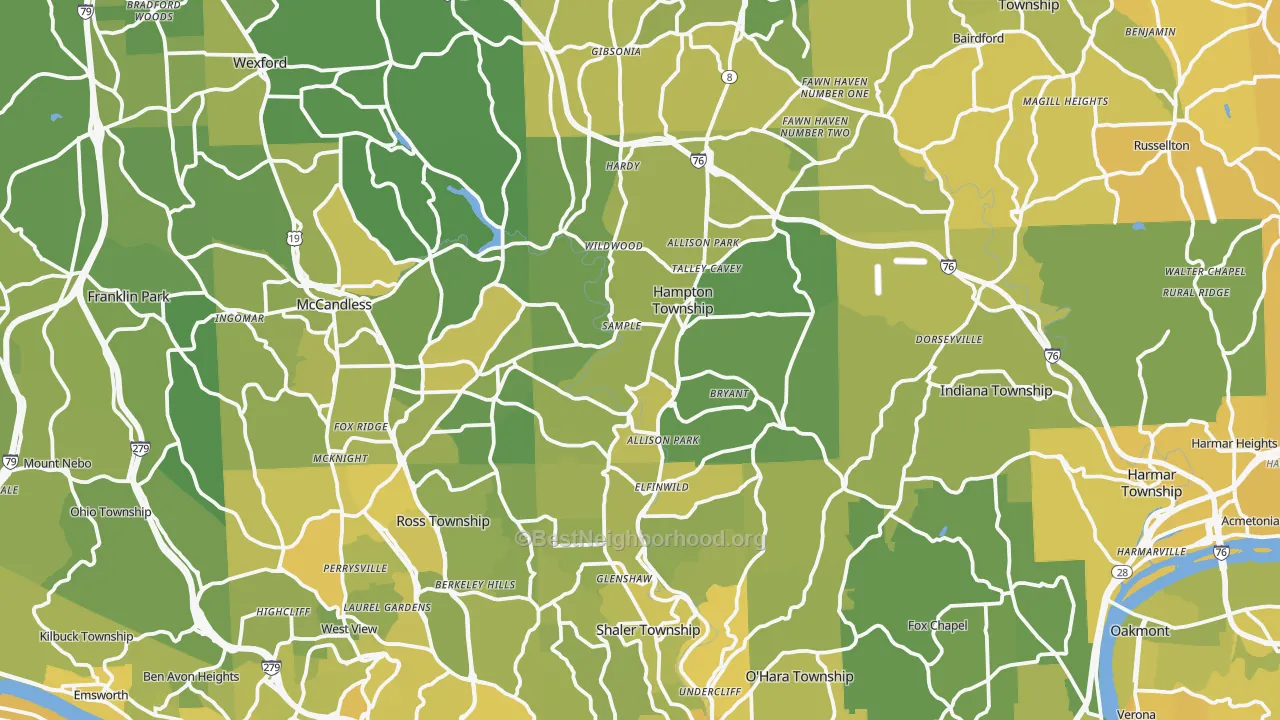
BestNeighborhood is the only ranking that scores 40 measures of daily life neighborhood by neighborhood and lets you re-weight every one of them yourself.
Allison Park's strengths and weaknesses
Where Allison Park ranks high
- Disaster safetyBetter than 99% of cities
- School gradeA+, better than 97% of cities
- Healthcare accessBetter than 98% of cities
- Crime safetyBetter than 89% of cities
- Cost of living vs incomeBetter than 88% of cities
Where Allison Park ranks low
- WalkabilityBetter than only 15% of cities
- Nice weatherabout 74 pleasant days a year, better than only 35% of cities
- Internet speedBetter than only 18% of cities
- BikingBetter than only 20% of cities
- Low property taxBetter than only 22% of cities
What it costs to buy a home in Allison Park
A household needs to earn about $99,000 a year to comfortably buy the median Allison Park home, at 20% down and today's 30-year rate. That is below the area's own median income of $134,033, so a typical household can afford the median home outright.
Where the monthly payment goes
Assumes a 20% down payment, a 6.7% 30-year fixed rate, and a 28% share of income going to the payment. The rate is the 2026-08-20 30-year fixed average, series MORTGAGE30US from the St. Louis Fed, which publishes Freddie Mac's weekly survey. Against the median home value, property tax uses Allison Park's effective rate of 1.46%, and insurance is estimated at 0.4% of home value a year.
Renting versus buying
At today's prices, buying tends to cost more than renting for about the first 7 years, then pulls ahead as rent keeps rising and the mortgage builds equity. The chart tracks the running cost of each.
Who lives in Allison Park
Allison Park runs older than the country.
Residents by age
Racial and ethnic makeup has its own map. See the race and diversity map for Allison Park.
Who works in Allison Park, and how
Work in Allison Park centers on health care & social and professional & technical. Unemployment is low, and employment has held roughly flat.
Largest industries
How people get to work
- Drive or carpool 72%
- Work from home 25%
- Transit, walk, or bike 4%
Life in Allison Park
Allison Park has more parkland per resident than 94% of cities. That concentrates in some parts of Allison Park and thins out in others, which the map shows.
What the weather is like in Allison Park, month by month
Allison Park sees roughly 74 pleasant days a year. July highs average about 85 degrees. January highs sit near 38, with lows near 20. The comfortable stretch runs May through September.
Show the monthly temperatures
| Month | Avg high | Avg | Avg low |
|---|---|---|---|
| January | 38° | 29° | 20° |
| April | 63° | 50° | 39° |
| July | 85° | 73° | 61° |
| October | 66° | 54° | 43° |
Flying in and out of Allison Park
Pittsburgh International sits about 15 miles away. It is a medium hub and boarded 4.8 million passengers in 2025, with 104 nonstop destinations.
The best schools in and around Allison Park
Schools across Allison Park average an A+, better than 97% of cities.
Top elementary schools
- Poff El SchA+ · 92% proficient
- Hosack El SchA+ · 90% proficient
- Wyland El SchA+ · 87% proficient
Top middle schools
- Dorseyville MsA+ · 80% proficient
- Hampton MsA+ · 72% proficient
- Carson MsA · 65% proficient
Top high schools
- Fox Chapel Area HsA+ · 91% proficient
- Hampton HsA+ · 80% proficient
- North Allegheny HsA+ · 79% proficient
Grades come from K-12 test scores, with scores projected for schools missing data. See every Allison Park school and its grade on SchoolGrade.
Allison Park measure by measure
Cards are ordered by how much each measure matters to you, so the ones you weighted highest come first. Expand to see every measure. Percentages compare Allison Park against the other 2,097 cities.
Who Allison Park suits
Remote workers
Cost of living against local pay beats 88% of cities and 25% already work from home.
Common questions about living in Allison Park
Is Allison Park a good place to live?
Using BestNeighborhood's default rankings, Allison Park ranks 117th of 2,098 cities. It scores highest on low disaster risk, good schools, and health care access, and lowest on walkability and the weather. How good it is for you depends on which of those you weight most, which the map lets you set.
Is Allison Park expensive to live in?
The median home is worth $343,987. The overall cost of living runs about 0% above the national average. Set against a $134,033 median income, cost of living beats 88% of cities.
Is Allison Park safe?
Yes, Allison Park is safer than 89% of cities. Safety varies a lot by neighborhood. Crime costs an estimated $172 per resident a year.
What is the weather like in Allison Park?
July highs average about 85 degrees, and January highs near 38 with lows near 20. That works out to about 74 pleasant days a year, more than 35% of cities.
Is Allison Park good for families?
Schools beat 97% of cities, crime safety beats 89%, and childcare runs $991 a month.
Compare Allison Park with other cities
Sources and methodology
Every measure on this page is scored for each neighborhood, then rolled up to Allison Park. Scores are absolute rather than ranked, which means a 60 in Allison Park represents the same real quantity as a 60 anywhere else, and the ranking is a weighted average of those absolutes. The map colors come from a national scale calibrated against a population weighted random sample of 5,000 neighborhoods. That absolute scoring is what no other places-to-live ranking does: it puts a single neighborhood, a town, a metro, and a state on one scale, so the same 40 measures answer both which metro to move to and which street inside it to buy on. Read the full methodology.
Allison Park detail on BestNeighborhood maps:
- Walk Grade for Allison Park: walkability, transit, and biking, measured on the real street network rather than by straight line distance.
- Noise in Allison Park: road, rail, and aviation sound modeling calibrated against federal ground truth measurements.
- Conservative vs liberal map of Allison Park: precinct level election results apportioned to neighborhoods.
- Mobile and cell coverage in Allison Park: carrier by carrier coverage behind the cell score.
Allison Park detail on related sites:
- CrimeGrade: neighborhood crime rates behind the crime safety score.
- ISPreports.org: provider by provider internet availability and advertised speeds.
- CoverageWatch: the car insurance premiums behind the cheap car insurance score.
Federal and public data:
- U.S. Census Bureau American Community Survey: income, home value, rent, vacancy, commute time and mode, educational attainment, home age, age structure, household type, industry, and race.
- NOAA Global Surface Summary of the Day: the daily station record behind the monthly temperatures and the pleasant-day count.
- FAA Passenger Boarding Data: airport size and annual passenger counts.
- Freddie Mac Primary Mortgage Market Survey: the 30-year fixed rate used in the cost-to-buy estimate.
- FBI Crime Data Explorer: reported offenses behind the tangible crime cost estimate.
- U.S. EPA Air Quality System: five year average air quality index.
- FEMA National Risk Index: expected annual loss from natural hazards.
- CDC PLACES: disease burden, preventable risk, and barriers to care.
- National Center for Education Statistics: school enrollment and assessment inputs behind the school grade.
- FCC National Broadband Map: internet and wireless availability.
- U.S. Bureau of Labor Statistics: employment and job growth behind the local economy score.
- Religious activity uses a proprietary religious signal measurement.
Your priorities
Move a slider to say how much a measure matters. Zero turns it off.