
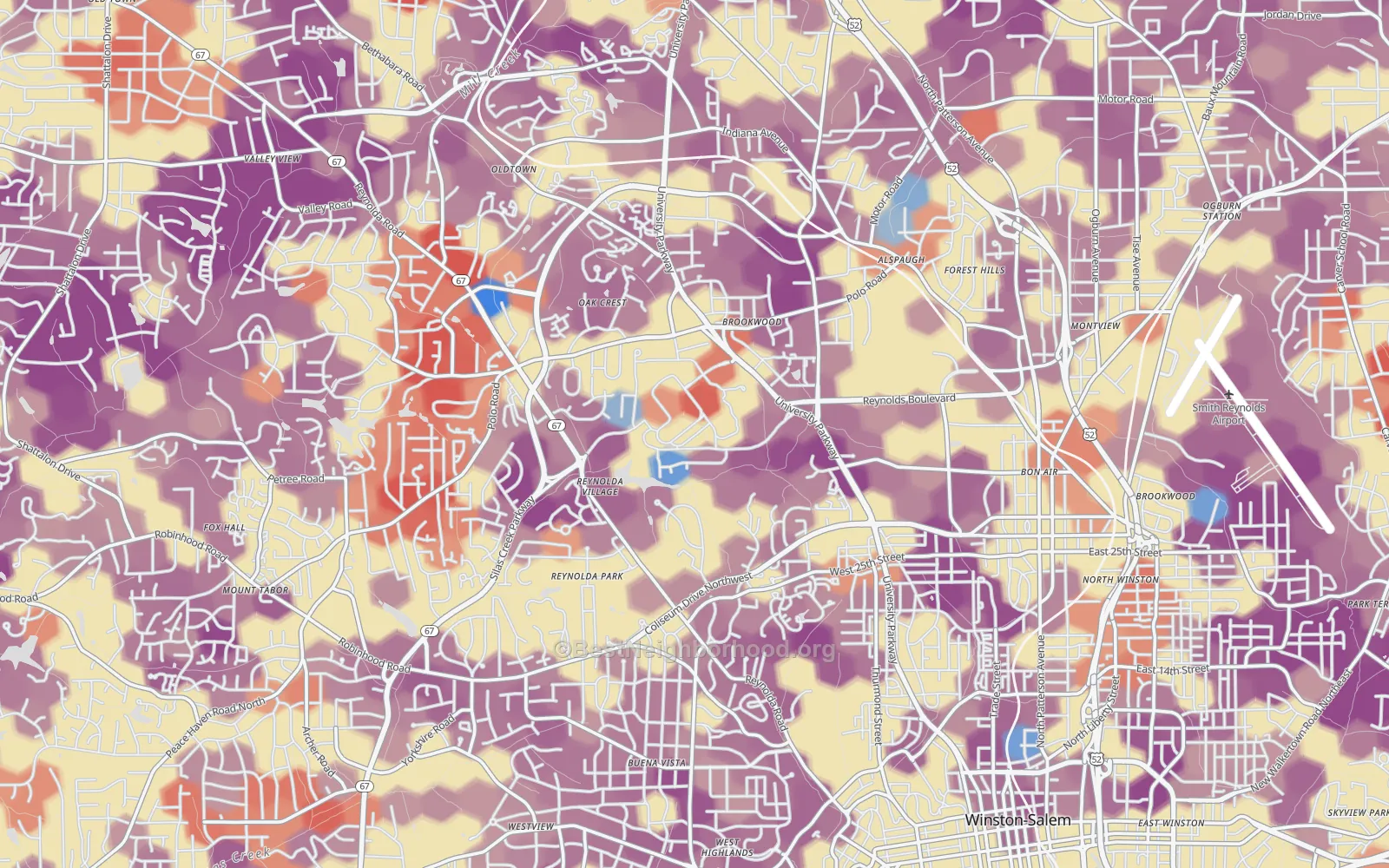
Best Cell Phone Coverage in Wake Forest University, Winston-Salem, NC
In Wake Forest University, Verizon has the best cell coverage, with a signal score of 84 out of 100. The gap to T-Mobile, in second at 79, is 5 points. Verizon and T-Mobile both give a strong signal to nearly every resident.
to rank the networks at your home, your work and the other places you go.
Verizon network
Strong signal for over 99% of Wake Forest University residents

BestNeighborhood may earn a commission from these links.
T-Mobile network
Strong signal for over 99% of Wake Forest University residents

BestNeighborhood may earn a commission from these links.
AT&T network
Strong signal for 90% of Wake Forest University residents

BestNeighborhood may earn a commission from these links.
This page is for anyone who wants the best cell phone coverage in Wake Forest University. It ranks Verizon, T-Mobile and AT&T by the signal people get, then shows the signal at 2 places people go and cheaper plans on the same networks, and lets you save home, work and other places to compare the networks there.

BestNeighborhood may earn a commission from some of the brands listed. Rankings come from the coverage data alone.
Source: FCC National Broadband Map, mobile coverage as of June 30, 2026.
Top cell phone providers in Wake Forest University at a glance
In Wake Forest University the signal scores are Verizon 84, T-Mobile 79 and AT&T 76, out of 100. Where 27% of residents live, Verizon beats the other national networks by a clear margin. The clear leader is T-Mobile for 14% of residents and AT&T for 1%.
Verizon leads here, while T-Mobile has the top score across North Carolina. AT&T does better here than its own North Carolina average, 76 against 60.
Signal scores run from 0 to 100, and excellent, good, fair and weak describe them from the top down. A strong signal is a score in the good or excellent range. Wake Forest University tops out at 84, 7 points above the best across North Carolina (T-Mobile, 77).
| Network and brands | Signal score | Residents with a strong signal | Land with service | Clearly best for |
|---|---|---|---|---|
| Verizon: Visible and Verizon | 84 Excellent | over 99% | over 99% | 27% of residents |
| T-Mobile: Mint Mobile, Bark, Boost Mobile and T-Mobile | 79 Good | over 99% | over 99% | 14% of residents |
| AT&T: Cricket Wireless and AT&T | 76 Good | 90% | over 99% | 1% of residents |
Too close to call, on the map, means the top two networks are within a few points of each other; 58% of residents live where that is so.
Plans come directly from Verizon Wireless.
BestNeighborhood may earn a commission from these links.
Cell signal at the places people go in Wake Forest University
The table gives each network's signal score at the college and the stadium in Wake Forest University, read at each spot from the same hexagons as the map. Of the 2 places, Verizon is clearly best at 2. The widest gap is at Wake Forest University: 91 for Verizon against 76 for T-Mobile.
| Place | Verizon | T-Mobile | AT&T |
|---|---|---|---|
| Wake Forest University | 91 Excellent | 76 Good | 85 Excellent |
| Kentner Stadium | 90 Excellent | 76 Good | 77 Good |
Cheap cell phone plans in Wake Forest University, by network
Brands that sell plans on a network use its towers, so they get that network's signal score here: Verizon 84, T-Mobile 79 and AT&T 76.
| Brand | Network | Plans from | Plans |
|---|---|---|---|
| Verizon network signal score 84 (Excellent) in Wake Forest University | |||
| Visible | Verizon | $35/mo | See Visible plans |
| Verizon Wireless | Verizon | See site | See Verizon plans |
| T-Mobile network signal score 79 (Good) in Wake Forest University | |||
| Mint Mobile | T-Mobile | $15/mo | See Mint Mobile plans |
| Bark (phones for kids) | T-Mobile | $29/mo | See Bark plans |
| Boost Mobile | T-Mobile | $35/mo | See Boost Mobile plans |
| T-Mobile | T-Mobile | See site | See T-Mobile plans |
| AT&T network signal score 76 (Good) in Wake Forest University | |||
| Cricket Wireless | AT&T | $35/mo | See Cricket Wireless plans |
| AT&T Wireless | AT&T | See site | See AT&T plans |
BestNeighborhood may earn a commission from these links. Rankings come from the coverage data alone.
5G coverage in Wake Forest University
5G reaches nearly everyone in Wake Forest University on every network, so the signal score is what tells them apart. Share of residents with 5G from each network: AT&T over 99%, T-Mobile over 99% and Verizon over 99%.
Questions about cell service in Wake Forest University
Is Verizon or T-Mobile better in Wake Forest University?
Verizon scores 84 out of 100 in Wake Forest University and T-Mobile 79. Verizon has the clearly best signal where 27% of residents live, T-Mobile where 14% live.
Do Visible, Mint Mobile and Cricket Wireless get the same coverage in Wake Forest University?
Yes. Each sells plans on a national network and uses its towers, so each gets that network's signal. In Wake Forest University, Visible uses Verizon's network (84 here), Mint Mobile uses T-Mobile's network (79 here) and Cricket Wireless uses AT&T's network (76 here). Some of their plans get lower priority when a tower is busy, but where the signal reaches is the network's.
How many cell phone providers serve Wake Forest University?
Three networks file coverage in Wake Forest University with the FCC: Verizon, T-Mobile and AT&T. Brands such as Visible, Mint Mobile and Cricket Wireless sell plans on those networks.
How can I get better cell reception at home in Wake Forest University?
The scores here describe the signal outdoors, and walls cut it, so check the map at your own address first. In Wake Forest University, Verizon gives a strong signal to over 99% of residents and T-Mobile to over 99%. If your network is weak where you live, a network that is strong there, or Wi-Fi calling, which Verizon, T-Mobile and AT&T all offer, usually helps more than a new phone.
How accurate is this coverage map of Wake Forest University?
The scores for Wake Forest University come from 49 hexagons of about 26 acres each, using the coverage each carrier files with the FCC. The carriers model that coverage; it is not a speed test, and it describes the signal outdoors. Each carrier runs its own model, so a gap of a few points can come from how they model it.
How the scores are made
Each signal score describes the cell signal outdoors in one hexagon of about 26 acres, from the coverage each carrier models and files with the Federal Communications Commission (FCC). The FCC sets the speed tiers and the moving-car test the same way for every carrier; each carrier models its own signal. A place's score averages its hexagons by the time people spend in each one: at home, at work, at school and on the road. These hour estimates come from Terra Lake Data, which developed the metric for use on CrimeGrade™. Shares of residents count where people live. It is a coverage estimate, not a speed test, and signal indoors is weaker.
How the signal score is made, and its limits
Sources
Federal Communications Commission, National Broadband Map: mobile coverage as of June 30, 2026 (published November 10, 2026): the signal scores, 5G and the moving-car coverage
U.S. Census Bureau: 2020 census residents in each hexagon; the American Community Survey and LEHD commuting data behind the time people spend in each one
National Center for Education Statistics: colleges and public high schools
Federal Aviation Administration: commercial airports
Overture Maps Foundation: hospitals and stadiums
BestNeighborhood may earn a commission from some of the brands listed. Rankings come from the coverage data alone.
By the BestNeighborhood data science team. Last updated November 2026.
Networks ranked by signal score in Wake Forest University
- #1Verizon network, Verizon Wireless plans: 84 Excellent. See Verizon plans
- #2T-Mobile network, Mint Mobile plans from $15/mo: 79 Good. See Mint Mobile plans
- #3AT&T network, Cricket Wireless plans from $35/mo: 76 Good. See Cricket Wireless plans
Mobile service in places near Wake Forest University
More on Wake Forest University: Internet providers · Best neighborhoods · Walk Grade · Noise · Demographics · Household income · Community health