
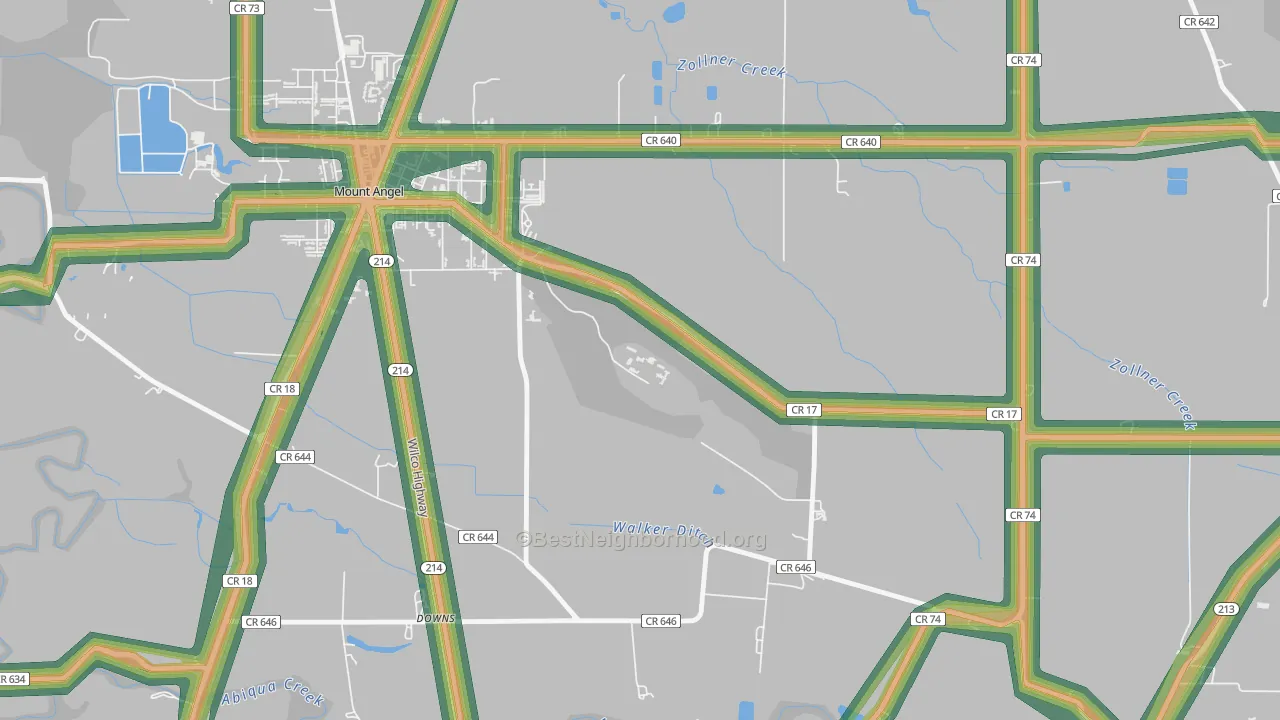
This map shows modeled outdoor noise across 97373 at 100-meter resolution, combining road, aviation, and rail sources. Green areas measure below 45 dBA. Orange and red exceed the EPA's 55 dBA outdoor threshold linked to long-term health effects. Use the layer toggles to view each source on its own or all together.
What the numbers sound like
- 30 dBAWhisper
- 40 dBASoft rainfall
- 45 dBAQuiet suburban street at night
- 50 dBAQuiet office
- 55 dBAEPA outdoor threshold: light traffic 100 ft away
- 60 dBANormal conversation an arm's length away
- 65 dBABusy restaurant
- 70 dBAHighway traffic 50 ft away
- 80 dBACity bus interior
Population Above the EPA Outdoor Threshold
The EPA's 55 dBA outdoor reference level is a common benchmark for residential noise exposure, especially for activity interference, annoyance, and long-term community noise concerns. About 0 97373 residents, or 0.0%, live above that level. By land area, 0.0% of 97373 is above 55 dBA.
See how noise in 97373 compares to similar-sized zip codes.
How Noise Is Distributed Across 97373
The bar chart below shows the share of 97373 residents in each noise band. About 100% of residents live below the EPA's 55 dBA threshold, and roughly 0% live in blocks above 60 dBA. A systematic review for the World Health Organization's 2018 Environmental Noise Guidelines found that the risk of ischemic heart disease rises about 8% for every 10 dB increase in long-term road traffic noise.
How 97373 Compares
97373 sits the lowest among the peer group. Below: how 97373's average outdoor noise and share of residents above the EPA threshold compare with 97384, 97310, 97036, and 97204.
Average noise level (dBA)
97373's 45.4 dBA pop-weighted average is the lowest among the peer group. Oregon as a whole averages 52.9 dBA, and the U.S. averages 52.0 dBA.
Share of residents above 55 dBA
About 0.0% of 97373 residents live in blocks where outdoor levels exceed the EPA's 55 dBA threshold. That's fewer than any of its peer group. Measured by land area instead, 0.0% of 97373's footprint sits above 55 dBA, against a Oregon average of 24.2% and a national average of 28.1%.
What This Means if You're Moving to 97373
- Distance from major roads matters more than the neighborhood name. Two homes in the same ZIP code can differ by more than 15 dBA when one sits 100 meters from a highway and the other 500 meters away. The model works at 100-meter resolution, so noise exposure changes block by block.
- Land cover sets how fast noise fades in the model. About 19% of 97373 is under tree canopy, about average for zip codes, and about 0% is impervious surface such as pavement and rooftops. Its most common land cover is pasture / hay. These figures come from USDA Forest Service and USGS satellite data at 30-meter resolution, and the model uses them to set the rate at which noise fades with distance in 97373.
Sources & Methodology
The BestNeighborhood noise model is calibrated against nearly one million federal ground-truth measurements across four states. Road noise is computed from segment-level federal traffic data and propagated outward using physics-based acoustic decay, with attenuation rates that depend on the surrounding land cover.
Federal datasets used:
FHWA Highway Performance Monitoring System: road geometry, traffic counts, lane configuration
U.S. DoT Bureau of Transportation Statistics National Transportation Noise Map: aviation and rail noise, road calibration ground truth
USGS / MRLC National Land Cover Database: land cover and impervious surface coverage
USDA Forest Service Tree Canopy Cover: vegetation density for sound propagation
U.S. Census Bureau TIGER/Line: block-level geography and population
U.S. EPA Levels Document: 55 dBA outdoor reference level
Health research cited:
World Health Organization Environmental Noise Guidelines systematic review (2018): road traffic noise and heart disease
All inputs are published federal datasets. Block-level noise is computed by combining road, rail, and aviation sound sources in the energy domain, the same physics used in professional environmental noise assessments. Read the full methodology.