
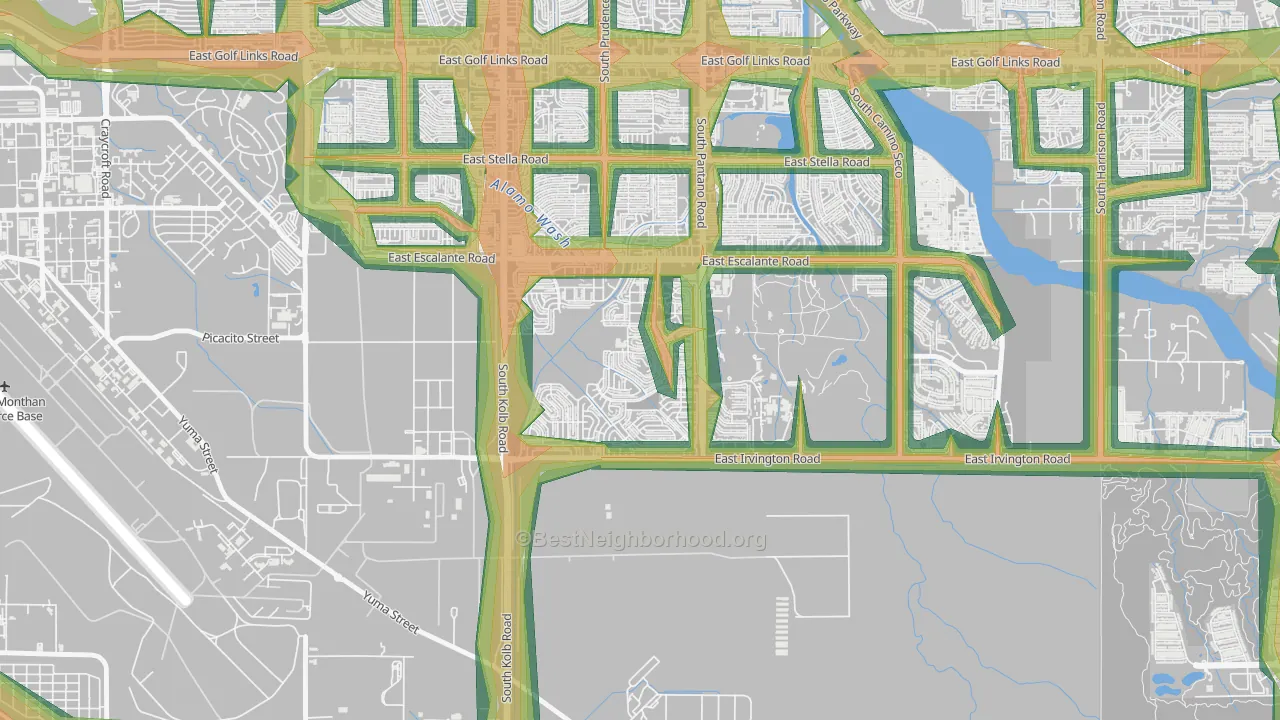
This map shows modeled outdoor noise across Groves Lincoln Park at 100-meter resolution, combining road, aviation, and rail sources. Green areas measure below 45 dBA. Orange and red exceed the EPA's 55 dBA outdoor threshold linked to long-term health effects. Use the layer toggles to view each source on its own or all together.
What the numbers sound like
- 30 dBAWhisper
- 40 dBASoft rainfall
- 45 dBAQuiet suburban street at night
- 50 dBAQuiet office
- 55 dBAEPA outdoor threshold: light traffic 100 ft away
- 60 dBANormal conversation an arm's length away
- 65 dBABusy restaurant
- 70 dBAHighway traffic 50 ft away
- 80 dBACity bus interior
Population Above the EPA Outdoor Threshold
The EPA's 55 dBA outdoor reference level is a common benchmark for residential noise exposure, especially for activity interference, annoyance, and long-term community noise concerns. About 1,677 Groves Lincoln Park residents, or 35.4%, live above that level. By land area, 38.4% of Groves Lincoln Park is above 55 dBA.
See how noise in Groves Lincoln Park compares to similar-sized neighborhoods.
Noise by Part of Groves Lincoln Park
Average noise levels for Groves Lincoln Park residents, grouped by direction from the center of Groves Lincoln Park. The highest population-weighted average is in southern Groves Lincoln Park; the lowest is in eastern Groves Lincoln Park, where just 15% of residents live in blocks above the EPA's 55 dBA threshold, about half the share in the loudest section.
Southern Groves Lincoln Park
37% of people above 55 dBA
Central Groves Lincoln Park
36% of people above 55 dBA
Northern Groves Lincoln Park
32% of people above 55 dBA
Southeastern Groves Lincoln Park
24% of people above 55 dBA
Eastern Groves Lincoln Park
15% of people above 55 dBA
To the human ear, noise in southern Groves Lincoln Park sounds about 36% louder than in eastern Groves Lincoln Park, a 4.4 dBA gap. Every 10 dBA roughly doubles perceived loudness. Within any of these directions, two homes a quarter mile apart can still differ by 10 or more dBA depending on how close they sit to a major highway.
Airport Noise
Tucson International (TUS) sits southwest of Groves Lincoln Park. The U.S. Department of Transportation models aviation noise around this airport from federal traffic data, and the model uses those federal measurements rather than synthetic predictions.
Blocks under the approach and departure paths carry combined road-plus-aviation noise, with some exceeding 55 dBA on the map's Overall layer. Blocks on the opposite side of Groves Lincoln Park, particularly to the northeast, show no measurable aviation contribution. Use the Aviation toggle on the map above to isolate the airport's footprint.
How Noise Is Distributed Across Groves Lincoln Park
The bar chart below shows the share of Groves Lincoln Park residents in each noise band. About 61% of residents live below the EPA's 55 dBA threshold, and roughly 2% live in blocks above 60 dBA. Long-term exposure in that range is linked to elevated stress hormones and cardiovascular risk.
How Groves Lincoln Park Compares
Groves Lincoln Park sits at the quieter end of the spectrum. Below: how Groves Lincoln Park's average outdoor noise and share of residents above the EPA threshold compare with Lakeside Park, Terra del Sol, Myers, and Julia Keen.
Average noise level (dBA)
Groves Lincoln Park's 53.5 dBA pop-weighted average is at the quieter end of the spectrum. Arizona as a whole averages 53.0 dBA and the U.S. averages 52.0 dBA. Both are lower than Groves Lincoln Park because most of either area is rural land away from major roads.
Share of residents above 55 dBA
About 35.4% of Groves Lincoln Park residents live in blocks where outdoor levels exceed the EPA's 55 dBA threshold. That's in the middle of its peer group. Measured by land area instead, 38.4% of Groves Lincoln Park's footprint sits above 55 dBA, against a Arizona average of 28.3% and a national average of 28.1%.
What This Means if You're Moving to Groves Lincoln Park
- Distance from highways matters more than the neighborhood name. Two homes in the same zip code can differ by 20 dBA if one sits 100 meters from 10E~IRVINGTON~~~~~~~~~~~RD~~~~~~ and the other 500 meters away. The model captures this at 100-meter resolution, so noise exposure changes block by block.
- Tree canopy can help reduce modeled noise exposure. Roughly 0% of Groves Lincoln Park is under tree cover (much lighter than most neighborhoods), and the dominant land cover is medium-intensity developed land. Both are measured from federal USDA Forest Service and USGS satellite imagery at 30-meter resolution. Streets with 60% or higher canopy show 3 to 5 dBA lower noise than comparable streets with bare ground or pavement, which is why the per-place decay rate above already accounts for it.
- Airport noise is directional. Tucson International's approach paths concentrate aviation noise to the southwest. Neighborhoods to the northeast of downtown show no measurable contribution from the airport.
Sources & Methodology
The BestNeighborhood noise model is calibrated against nearly one million federal ground-truth measurements across four states. Road noise is computed from segment-level federal traffic data and propagated outward using physics-based acoustic decay, with attenuation rates that depend on the surrounding land cover.
Federal datasets used:
FHWA Highway Performance Monitoring System: road geometry, traffic counts, lane configuration
U.S. DoT Bureau of Transportation Statistics National Transportation Noise Map: aviation and rail noise, road calibration ground truth
USGS / MRLC National Land Cover Database: land cover and impervious surface coverage
USDA Forest Service Tree Canopy Cover: vegetation density for sound propagation
U.S. Census Bureau TIGER/Line: block-level geography and population
U.S. EPA Levels Document: 55 dBA outdoor reference level
All inputs are published federal datasets. Block-level noise is computed by combining road, rail, and aviation sound sources in the energy domain, the same physics used in professional environmental noise assessments. Read the full methodology.