
Put this Walk Grade on your own site with the free Walk Grade widget.
Seven Eagles earns a Walk Grade of D- with a score of 8 out of 100. Walk Grade measures whether a person could handle daily life walking without a car, and whether a reasonable person would find the walk pleasant or stressful. It traces the real route to the places people need to go: grocery stores, schools, parks, and more. The grade accounts for things like stressful roads that have to be crossed, traffic noise, how much shade there is, and much more. About 0% of residents live in walkable areas, 94% live in car-dependent areas, and 6% live where life without a car is harder but possible.
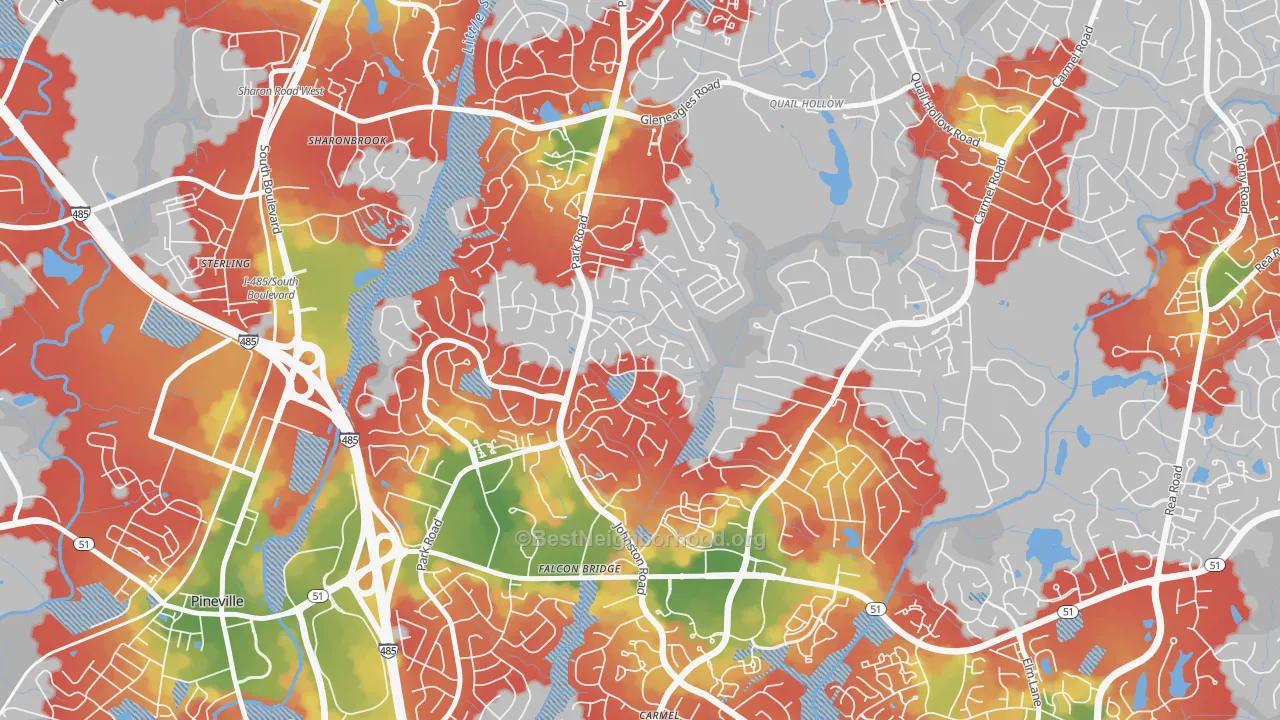
Walk Grade map of Seven Eagles, Charlotte, NC
Greener blocks are more walkable; red blocks are car-dependent. Areas in grey score near zero and are left unshaded. Sharp edges along freeways and wide arterials are real, because those roads cut the walking network.
What the walk is actually like in Seven Eagles
Most walk scores stop at distance: how far is the store. Walk Grade also reads what the walk is like along the way. Three of those inputs are easy to compare against the rest of the country.
Seven Eagles streets carry about 33% tree cover where people walk, above the typical US neighborhood (10%).
Residents live among about 270 street intersections per square mile, about even with the typical US neighborhood.
Loud, fast arterials make up about 0.9% of the area's main roads, above most US neighborhood areas.
Share of Seven Eagles residents at each Walk Grade level
Every block is graded, then residents are sorted by the grade where they live. 0% live in areas graded B-plus or higher; 94% live in areas graded D or lower.
Walk Grade by part of Seven Eagles
The most walkable part of the neighborhood is southern Seven Eagles, with a Walk Grade of 12. The least walkable is central Seven Eagles, at 5, a gap of 7 points. Within any one direction, two blocks can still differ sharply depending on the streets and crossings between them.
Southern Seven Eagles
Northern Seven Eagles
Central Seven Eagles
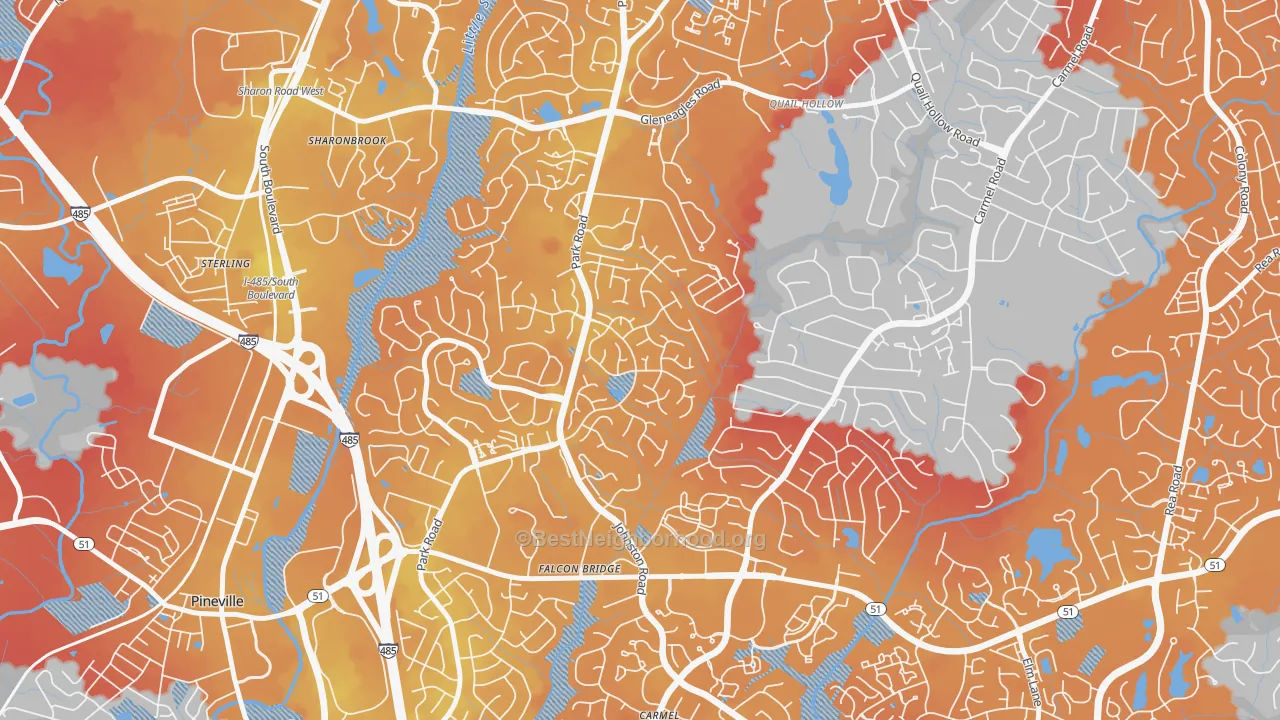
Transit Grade map of Seven Eagles, Charlotte, NC
Transit Grade asks whether a person could live here without a car. It scores the service at the front door in minutes, the walk to the nearest stop plus the wait for the next bus or train, then adds where those lines can take a rider. At a Transit Grade of 28 out of 100, Seven Eagles sits above most US neighborhood areas for car-free access.
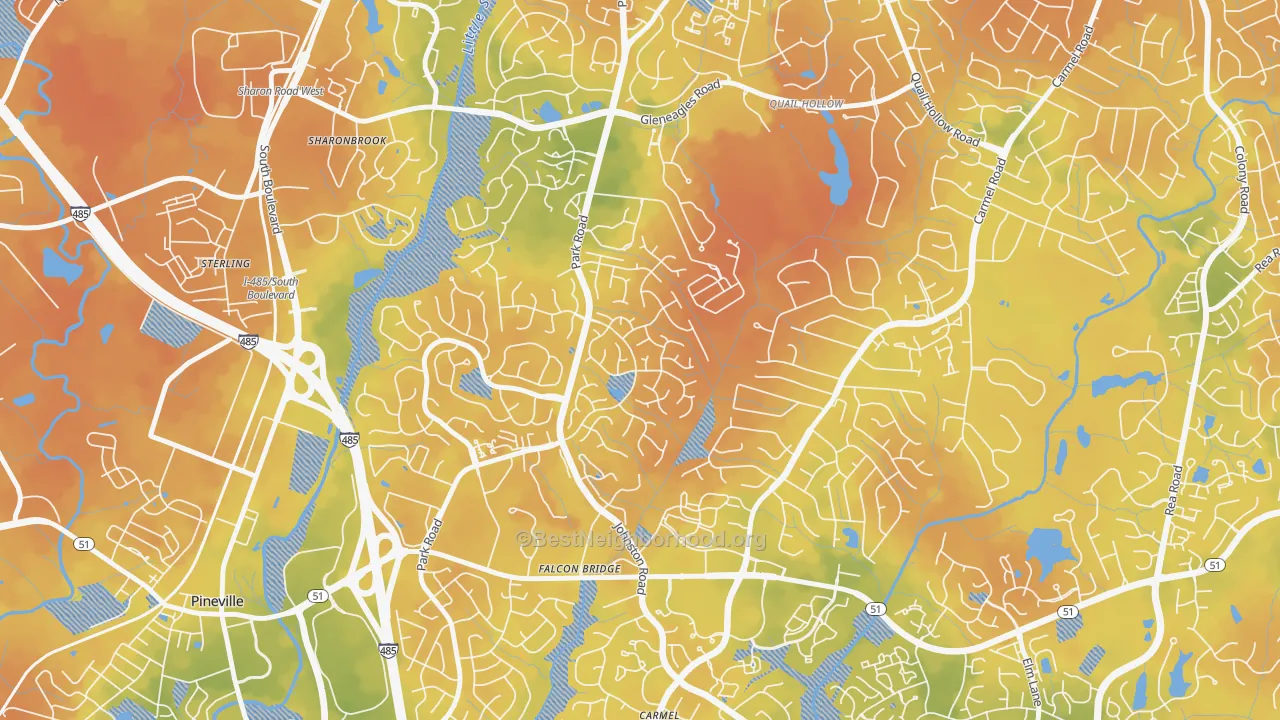
Bike Grade map of Seven Eagles, Charlotte, NC
Bike Grade asks whether a bike could replace a car. It weighs protected bike lanes, hills, destinations within a longer bike range, and links to transit, and it rewards places where the ride stays on calm, low-traffic streets. Its Bike Grade of 38 reflects the bike network, the hills, and how much of the ride sits on calm, low-traffic streets.
Seven Eagles next to similar places
Compared with neighborhood areas of a similar size, here is how Seven Eagles scores for walkability.
Why this reads lower than distance-only scores
A score that measures straight-line distance can call a place walkable when a store sits 200 meters away across a freeway. Walk Grade measures the real route to that store, so the freeway detour, the arterial crossings, and the missing sidewalks all count. The number is lower, and it matches the walk a person would actually take. The full method, including the destination model and every route penalty, is documented on the Walk Grade methodology page.
Neighborhood crime is folded in as a small adjustment, from BestNeighborhood's CrimeGrade data, including theft for the bike score.
Sources
- Overture Maps Foundation. Three layers: Places (the destinations), Transportation (every street, footpath, sidewalk, crossing, and driveway in the routing graph), and Buildings (footprints used to estimate store size and to filter out home-based businesses registered at a house).
- Highway Performance Monitoring System (HPMS), U.S. Federal Highway Administration. Traffic volume, speed, and lane counts behind the modeled road-noise surface that drives the crossing and walk-along-a-stroad penalties. Processed through the BestNeighborhood road-noise model.
- National Land Cover Database, Tree Canopy Cover, U.S. Geological Survey and the MRLC Consortium. Satellite tree-canopy percentage sampled along each road segment for the shade term.
- USGS 3D Elevation Program (3DEP). Elevation used to compute street grade for the Bike Grade hill term.
- National GTFS transit feeds. Full published schedules (routes, trips, frequencies) for the Transit Grade.
- OpenStreetMap (via Geofabrik). On-street bike-lane tagging that supplements the Overture network for the Bike Grade.
- Census LEHD LODES, U.S. Census Bureau. Jobs by workplace, used to weight where transit can take you.
- Census TIGER/Line geography and block population, U.S. Census Bureau. Block and block-group boundaries and resident counts used to roll hex grades up to neighborhoods, cities, zip codes, metros, counties, and states.
- American Community Survey 5-year estimates, U.S. Census Bureau. Commute-mode shares (walk, bike, transit) used for the Bike Grade and for the pedestrian-death research above.
- Kontur Population and LandScan. Population density used to set the metro extent and normalize the score.
- Google Places. A selective backfill that classifies a small set of food stores Overture leaves uncategorized. Overture remains the primary source of destinations.
- Fatality Analysis Reporting System (FARS), U.S. National Highway Traffic Safety Administration. Pedestrian and cyclist traffic deaths used in the safety research. Not an input to the Walk Grade map.
- CrimeGrade. Neighborhood crime percentiles used for the small safety nudge.
- PeopleForBikes Bicycle Network Analysis and the Furth-Mekuria Level-of-Traffic-Stress framework it builds on. Inspiration for the Bike Grade traffic-stress gate, adapted to our data, not copied.
Method reviewed by the BestNeighborhood data science team. Last updated August 2026.