
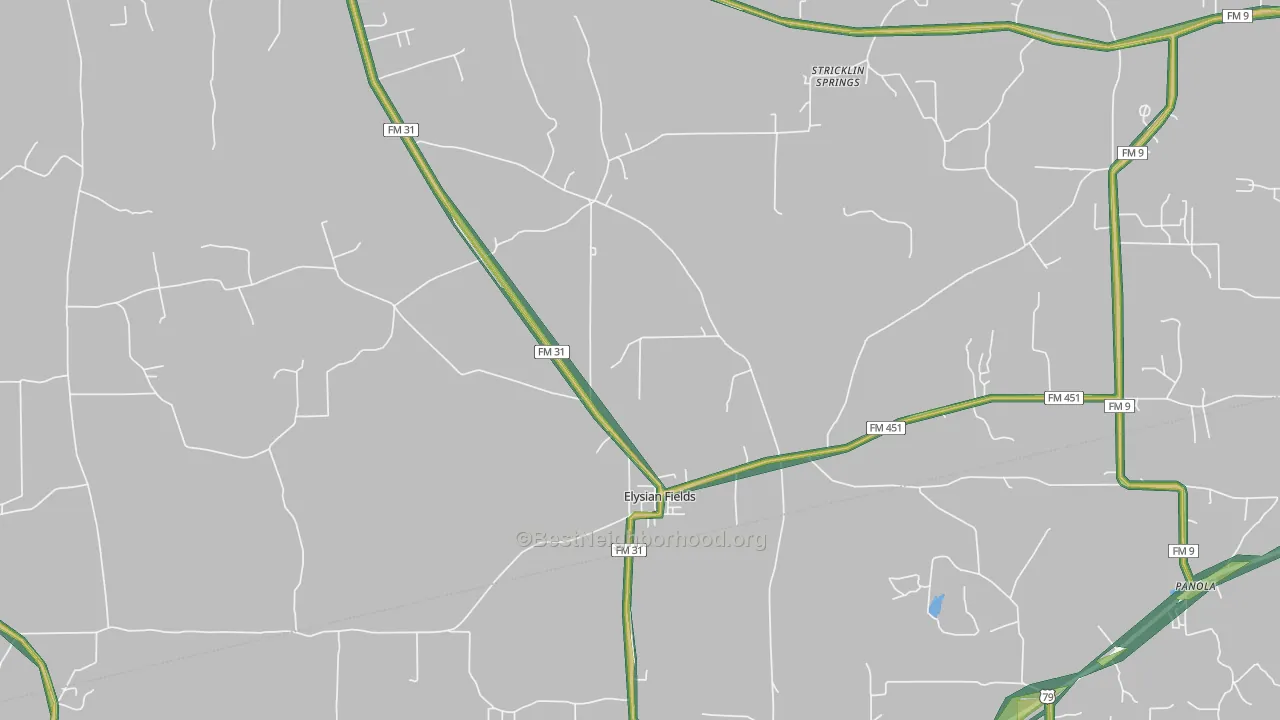
This map shows modeled outdoor noise across Elysian Fields at 100-meter resolution, combining road, aviation, and rail sources. Green areas measure below 45 dBA. Orange and red exceed the EPA's 55 dBA outdoor threshold linked to long-term health effects. Use the layer toggles to view each source on its own or all together.
What the numbers sound like
- 30 dBAWhisper
- 40 dBASoft rainfall
- 45 dBAQuiet suburban street at night
- 50 dBAQuiet office
- 55 dBAEPA outdoor threshold: light traffic 100 ft away
- 60 dBANormal conversation an arm's length away
- 65 dBABusy restaurant
- 70 dBAHighway traffic 50 ft away
- 80 dBACity bus interior
Population Above the EPA Outdoor Threshold
The EPA's 55 dBA outdoor reference level is a common benchmark for residential noise exposure, especially for activity interference, annoyance, and long-term community noise concerns. About 41 Elysian Fields residents, or 1.9%, live above that level. By land area, 2.5% of Elysian Fields is above 55 dBA.
See how noise in Elysian Fields compares to similar-sized cities.
Noise by Part of Elysian Fields
Average noise levels for Elysian Fields residents, grouped by direction from the center of Elysian Fields. The highest population-weighted average is in northern Elysian Fields; the lowest is in southern Elysian Fields, where just 1% of residents live in blocks above the EPA's 55 dBA threshold, about two-thirds of the share in the loudest section.
Northern Elysian Fields
2% of people above 55 dBA
Eastern Elysian Fields
2% of people above 55 dBA
Southeastern Elysian Fields
2% of people above 55 dBA
Northwestern Elysian Fields
1% of people above 55 dBA
Southern Elysian Fields
1% of people above 55 dBA
To the human ear, noise in northern Elysian Fields sounds about 65% louder than in southern Elysian Fields, a 7.2 dBA gap. Every 10 dBA roughly doubles perceived loudness. Within any of these directions, two homes a quarter mile apart can still differ by 10 or more dBA depending on how close they sit to a major highway.
How Noise Is Distributed Across Elysian Fields
The bar chart below shows the share of Elysian Fields residents in each noise band. About 99% of residents live below the EPA's 55 dBA threshold, and roughly 0% live in blocks above 60 dBA. A systematic review for the World Health Organization's 2018 Environmental Noise Guidelines found that the risk of ischemic heart disease rises about 8% for every 10 dB increase in long-term road traffic noise.
How Elysian Fields Compares
Elysian Fields sits at the quieter end of the spectrum. Below: how Elysian Fields's average outdoor noise and share of residents above the EPA threshold compare with DeBerry, Waskom, Tatum, and Harleton.
Average noise level (dBA)
Elysian Fields's 41.2 dBA pop-weighted average is at the quieter end of the spectrum. Texas as a whole averages 50.8 dBA, and the U.S. averages 52.0 dBA.
Share of residents above 55 dBA
About 1.9% of Elysian Fields residents live in blocks where outdoor levels exceed the EPA's 55 dBA threshold. That's in the middle of its peer group. Measured by land area instead, 2.5% of Elysian Fields's footprint sits above 55 dBA, against a Texas average of 22.8% and a national average of 28.1%.
What This Means if You're Moving to Elysian Fields
- Distance from major roads matters more than the neighborhood name. Two homes in the same ZIP code can differ by more than 15 dBA when one sits 100 meters from a highway and the other 500 meters away. The model works at 100-meter resolution, so noise exposure changes block by block.
- Land cover sets how fast noise fades in the model. About 69% of Elysian Fields is under tree canopy, much heavier than most cities, and about 3% is impervious surface such as pavement and rooftops. Its most common land cover is evergreen forest. These figures come from USDA Forest Service and USGS satellite data at 30-meter resolution, and the model uses them to set the rate at which noise fades with distance in Elysian Fields.
Sources & Methodology
The BestNeighborhood noise model is calibrated against nearly one million federal ground-truth measurements across four states. Road noise is computed from segment-level federal traffic data and propagated outward using physics-based acoustic decay, with attenuation rates that depend on the surrounding land cover.
Federal datasets used:
FHWA Highway Performance Monitoring System: road geometry, traffic counts, lane configuration
U.S. DoT Bureau of Transportation Statistics National Transportation Noise Map: aviation and rail noise, road calibration ground truth
USGS / MRLC National Land Cover Database: land cover and impervious surface coverage
USDA Forest Service Tree Canopy Cover: vegetation density for sound propagation
U.S. Census Bureau TIGER/Line: block-level geography and population
U.S. EPA Levels Document: 55 dBA outdoor reference level
Health research cited:
World Health Organization Environmental Noise Guidelines systematic review (2018): road traffic noise and heart disease
All inputs are published federal datasets. Block-level noise is computed by combining road, rail, and aviation sound sources in the energy domain, the same physics used in professional environmental noise assessments. Read the full methodology.